New method helps assess climate vulnerability of protected areas
Climate change is a challenge for Protected Areas (PA), such as national parks. It can affect biodiversity, infrastructure, and income from tourism. With limited resources, how should efforts be prioritized to meet those challenges? EfD South Africa researchers developed a framework to assess PA’s vulnerability to climate change. The framework helps prioritize resource allocation.
SANParks (South African National Parks) and EfD have collaborated for many years, but this project came about almost by coincidence. Kevin Coldrey, a master’s student at that time, was attending a guest lecture by Wendy Foden, a Climate Change Scientist at SANParks. She gave the students an exercise on assessing the climate vulnerability of national parks.
“Raised awareness in the organization”
“Right after the lecture, Kevin approached me and said he wanted to do a project on this. We were thrilled because this was something we had just started to look into ourselves. And we found the results very, very useful,” she said.
“The paper has very good visualizations. It’s very helpful to raise awareness within the organization of SANParks and inform management,” said Wendy Foden.
Kevin Coldrey ran the project quite independently as his master’s thesis, supervised by Wendy Foden and EfD South Africa researcher Jane Turpie. Similar studies have been conducted in the Global North, but one aspect that made this study especially valuable was that it considered SANPark’s dependency on tourism income.
“The framework assesses vulnerability from both an ecological and economic perspective, integrating the two components into a tool that can be used to rank conservation areas in terms of vulnerability while simultaneously highlighting the key vulnerabilities per conservation area. These aspects make the framework unique,” explains Kevin Coldrey.
Helps allocate resources
The vulnerability to climate change impact was assessed and combined with each national park’s capacity to adapt to these climate threats (management capacity, adjacent land use, and financial strength). The 19 national parks received a vulnerability score and rank based on the scoring in several categories. Since the parks are managed as a national network, the researchers explored the best allocation of resources. Each park’s importance to the network’s biodiversity conservation and revenue generation was estimated and used to weigh overall vulnerability scores and ranks.
The parks showed different combinations of the potential impact of climate change and the capacity to adapt. It turned out that the former had a greater influence on vulnerability. Mapungubwe National Park emerged as the most vulnerable to climate change despite its relatively high adaptive capacity, mostly because of large projected changes in species and resource use. Climate change vulnerability rankings differed markedly once importance weightings were applied; Kruger National Park was the most vulnerable under both importance scenarios.
“Our PA assessment tool may be used to prioritize resource allocation across PA networks and can be applied from local to global scales,” explained Kevin Coldrey.
Close collaboration with WWF
Another major user of the framework is the WWF Climate Change Directorate in assessing the vulnerability of protected areas in Africa. Kevin Coldrey and Jane Turpie worked closely with Harisoa Hasina Rakotondrazafy, the coordinator of the WWF Africa Adaptation Hub, based in Madagascar. They started assessing climate change impacts on protected areas in Kenya together with WWF’s Kenya team using Kevin’s framework.
“All in all, we covered 263 protected areas in 15 countries in eastern, western, and southern Africa,” said Harisoa Rakotondrazafy.
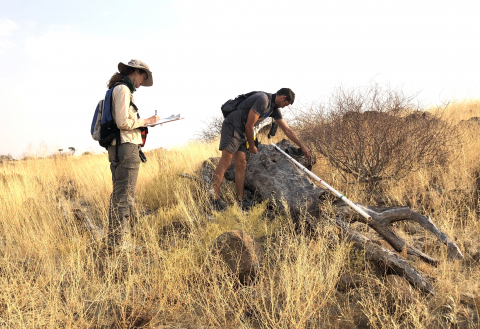
This included a lot of desktop work, but also field work, to assess how climate change affects those protected areas.
“The work we did with him guided adaptation interventions and to leverage funding for some projects.”
Presented at Africa Protected Areas Congress
The framework got even more leverage. In 2022, the WWF Africa Adaptation Hub participated in the first Africa Protected Areas Congress (APAC) in Kigali, Rwanda.
“We led the climate change component of that congress. The work that we had done with Kevin was the foundation of our agenda.,” said Harisoa Rakotondrazafy.
“After APAC, we established a close cooperation with Africa Wildlife Foundation to push this agenda on climate change and protected areas for Africa,” she said.
“Many protected areas are highly vulnerable to climate change and urgently need protection, but they are also part of the solution to adapting to climate change.”
Facts
EPRU (EfD South Africa) has collaborated with SANParks since 2007. SANParks and EfD’s co-generated knowledge has led to real impact within SANParks and its broader network.
The work presented in this article, led by Kevin Coldrey, with the climate change impact assessment tool, was a second-place winner for EfD’s Policy Impact Award 2024.
Read the study Assessing protected area vulnerability to climate change in a case study of South African national parks, which was published in Conservation Biology.
IGE Fellows contributed to national plans for clean cooking
How can we involve the private sector in a transition to clean cooking in Ethiopia? This was the...
Fish farmers record 20 percent better yield one year after EfD training
Nigeria's aquaculture industry has received a significant boost, thanks to EfD Nigeria’s effort to...
Rising temperatures cause lost incomes for informal workers
A study by EfD researchers Saudamini Das and E. Somanathan found that high temperatures cause...
Building trust among stakeholders was key for successful policy engagement in fisheries
EfD Colombia’s researchers show that involving experts from public institutions at an early stage...
Researchers and water company collaborates - poor people could buy more water
A team consisting of EfD Kenya, international associates, and the Nairobi City Water and Sewer...
EfD-funded project using laser technology improves rice farming in Vietnam
After three years of implementation, a laser-assisted land leveling project in the Mekong Delta of...