

Review process helps guide institutional development
Good institutional settings contribute to efficient research environments. EfD invests in institutional structures including, among others, administrative capacity and systems, data management, use of AI, and institutional learning between centers. The support is tailored to the specific needs of each center.
EfD’s largest program, known as GLOBEN EfD, was reviewed in 2024 by external experts on its performance from 2021 to 2023. The focus was on research, financial and institutional sustainability, and collaboration, a procedure that takes place every three years.
The research assessment was very thorough, evaluating the quality of scholarly output, its impact, and the research environment at EfD centers. A concern was that when academic quality improves, local relevance and impact may decrease. However, the evaluation revealed that EfD’s research remains highly relevant locally, driving substantial impact while maintaining rigorous international academic standards.
The overall evaluation was very positive. The review team also provided suggestions for further improvements, such as increasing the use of AI, improving the policy interaction within the collaborative programs, and enforcing marketing activities.
Important steps taken in 2025 include the recently launched professional support services network, connecting admin staff from the respective centers, and providing a comprehensive training session in connection with the Annual Meeting.
Another important step was an MoU signed between the University of Addis Ababa and EfD. The MoU has paved the way for shifting the institutional home of EfD Ethiopia.
Finally, EfD has encouraged the efforts made by the University of Rwanda to become an EfD center benefitting from the contacts and experiences gained from the ongoing PhD program in environmental economics and the Inclusive Green Economy program.
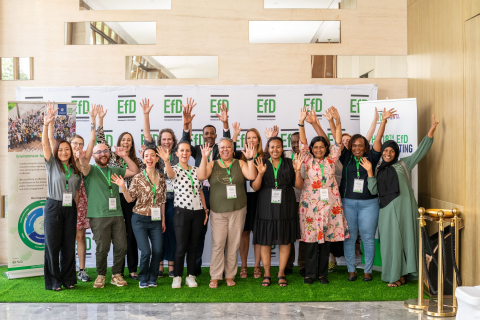
Workshop focused on building administrative capacity across centers
EfD held a four-day Professional Support Services (PSS) network workshop during the Annual Meeting...

AI's growing role in EfD - research, education and policy engagement
The use of artificial intelligence (AI) within the EfD initiative has increased over the last year...