
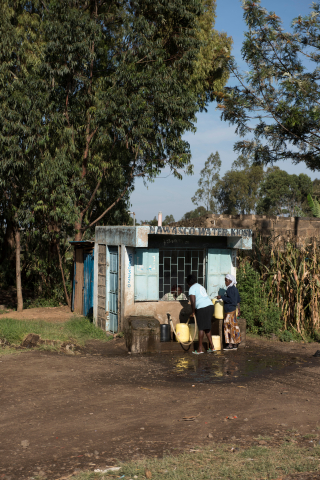
Researchers and water company collaborates - poor people could buy more water
A team consisting of EfD Kenya, international associates, and the Nairobi City Water and Sewer Company has, over the last decade, collaborated to solve challenges related to providing and funding affordable and resilient water and sanitation services in Nairobi. In addition, they have shared their knowledge with colleagues around the world. And their collaboration continues to generate positive outcomes.
The team received the EfD Policy Impact Award 2024 for a suite of research projects, all supported by EfD and developed in close collaboration between the EfD researchers and the Nairobi City Water and Sewer Company (NCWSC).
“There are many benefits from our point of view,” says Mbutu Mwara, the planning, monitoring, and evaluation manager at NCWCS and one of the company's key partners.
“EfD provides us with evidence-based facts, which makes it easier to convince regulators and other stakeholders about our proposals. It also helps us improve the efficiency of our operations,” he says.
The main advantage for the EfD researchers is to get first-hand information about issues the water company is struggling with. This allows them to fine-tune their research to be truly policy-relevant. They also get access to relevant data.
“It's an excellent working relationship and has resulted in many impactful studies, says Richard Mulwa, Director at EfD Kenya.
“The collaboration has also connected us with other stakeholders in the water sector.”
Poor people could purchase more water
The collaboration started about a decade ago with a project on the subsidies in the water tariff system, the increasing block tariff (IBT), implemented in Nairobi, and how it affected low-income households. IBT is among the most widely used water tariffs, particularly in developing countries. This is partly due to the perception that the IBT is an effective way to target subsidies to low-income households.
“We found, however, that high-income residential and non-residential customers got a larger share of the subsidies. Poor people, who often don’t have access to piped water but purchase water at kiosks, were paying a higher price for their water,” explains David Fuente, EfD International Associate Researcher and part of the collaboration since the beginning.
This study led to a change in how NCWSC priced water from public kiosks in low-income communities. Also, the demand for water at the water kiosks increased by over 50% after the new tariff was implemented, with implications for poverty reduction and health improvements.
Paved the way for further collaboration
“The initial project paved the way for further collaborative research. We identified additional issues related to pricing and tariffs, consumer behavior, and customer bill payments that are critical for NCWSC and other utilities in the Global South as they strive for financial sustainability,” says David Fuente.
One collaborative study showed that a simple uniform volumetric price outperformed the commonly used Increasing Block Tariff (IBT) in all policy-relevant metrics that were considered in the study.
Options to increase revenues
Some studies have suggested opportunities how to generate more revenues, which are needed to maintain the water infrastructure. The latest tariff implemented by NCWSC, for instance, introduced a pricing structure that improves the revenue generation from non-residential customers.
A study on what customers regard as a fair price for water showed that customers who got information about the capital intensity of water service delivery were willing to pay a 30% higher price. This showed that active communication can build acceptance for price increases necessary to improve services. After this project was completed, Nairobi Water increased its activities on social media.
“We are now covering 100% of our operational costs and can also do minor investments,” says Mbutu Mwara.
Cross-country knowledge sharing
NCWSC is widely considered to be a high-performing utility in the East Africa region, and NCWSC hosts delegations from other countries for peer-learning exchanges. This provides opportunities for EfD Kenya’s partnership with NCWSC to have an even broader impact. For example, NCWSC has hosted delegations from Ethiopia, Philippines, and Latin America to share best practices in utility management. Such peer-to-peer learning has the potential for policy impact at a much broader level.
“Other water companies are interested in, for instance, how we deal with the challenges in providing our services to informal settlements, our technical solutions, such as mobile-aided water meter reading systems, and our customer management systems,” relates Mbutu Mwara.
IGE Fellows contributed to national plans for clean cooking
How can we involve the private sector in a transition to clean cooking in Ethiopia? This was the...
Fish farmers record 20 percent better yield one year after EfD training
Nigeria's aquaculture industry has received a significant boost, thanks to EfD Nigeria’s effort to...
Rising temperatures cause lost incomes for informal workers
A study by EfD researchers Saudamini Das and E. Somanathan found that high temperatures cause...
Building trust among stakeholders was key for successful policy engagement in fisheries
EfD Colombia’s researchers show that involving experts from public institutions at an early stage...
New method helps assess climate vulnerability of protected areas
Climate change is a challenge for Protected Areas (PA), such as national parks. It can affect...
EfD-funded project using laser technology improves rice farming in Vietnam
After three years of implementation, a laser-assisted land leveling project in the Mekong Delta of...