
Nudging people to save water and power
Having competitions between staff, appointing water-saving ‘champions’ in your office block, or recognising people for their efforts to use energy more sparingly: these are small but powerful ways
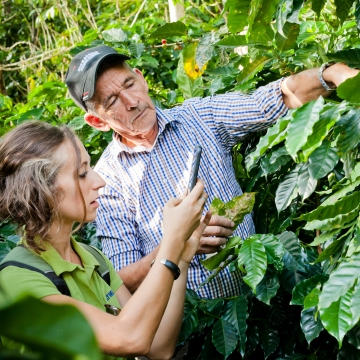
Having competitions between staff, appointing water-saving ‘champions’ in your office block, or recognising people for their efforts to use energy more sparingly: these are small but powerful ways
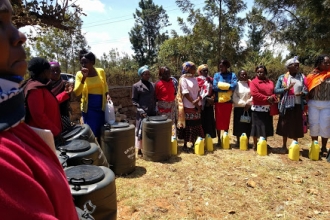
The EfD research project: Short- and long-term effects of exogenously reducing water collection times on school attendance, hours studying and time use: Meru County, Kenya; involves an experiment to…
Payments for ecosystem services (PES) typically reward landowners for managing their land to provide ecosystem services that would not otherwise be provided. REDD+—Reduced Emissions from Deforestation and Forest Degradation—is a form of PES aimed at decreasing carbon emissions from forest conversion and extraction in lower-income countries. A key challenge for REDD+ occurs when it is implemented at a group, rather than an individual landowner, level.
Risk aversion has generally been found to decrease in income. This may lead one to expect that people in poor countries will be more risk averse than inhabitants of rich countries. Recent comparative findings with students suggest the opposite, potentially giving rise to a risk-income paradox. Findings with students, however, may result from selection effects. We test whether a paradox indeed exists by measuring the risk preferences of over 500 household heads across several regions in the highlands of Ethiopia.
This paper tests the effect of stake size on ambiguity attitudes. Compared to a baseline condition, the paper find subjects to be more ambiguity seeking for small probability gains and large-probability losses under high stakes. They are also more ambiguity averse for large-probability gains and small-probability losses. the study traces these effects back to stake effects on decisions under risk (known probabilities) and uncertainty (unknown probabilities). For risk the paper replicates previous findings.

CAPE TOWN: Appointing a water-saving ‘champion’ in an office block context could be one way that municipalities and companies in South Africa can respond quickly and cheaply to the water restrictions…
Behavioural attitudes toward risk and time, as well as behavioural biases such as present bias, are thought to be important drivers of unhealthy lifestyle choices. This paper makes the first attempt to explore the possibility of training the mind to alter these attitudes and biases, in particular health-related behaviors, using a randomized controlled experiment. The training technique we consider is a well-known psychological technique called \mindfulness", which is believed to improve self-control and reduce stress.
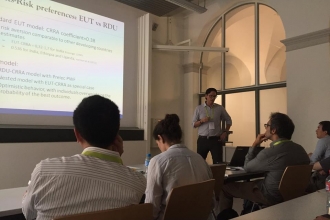
This past June, EfD Central America researchers Laura Villalobos and Francisco Alpizar presented at the European Association of Environmental and Resource Economists 22nd Annual Conference in Zurich…
Abstract: In Rwanda, rural water supply is not uniformly distributed. Rural areas are characterized by differences in the distance to the nearest water point and in water quality for domestic water, by watering frequency and water availability for irrigation water, and by the price for both. A household's perception of further improvements in water supply will, therefore, depend heavily on the situation it currently faces. The authors used a choice experiment to model how the individual status quo (SQ) affects preferences.
Abstract: In this paper, we examine the relative influence of individual decisions on joint household decisions, and whether and to what extent joint choices are more or less patient than individual choices in households. We find that both spouses have a significant influence on joint decisions, whereas husbands on average have a stronger influence than wives. Moreover, we find a substantial share of choice shifts from individual to joint household decisions, i.e. joint decisions are either more patient or more impatient than both individual choices.