| Energy, Gender, Policy Design | India

Does electrification illuminate women's lives?

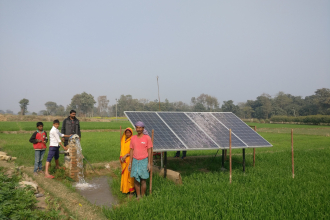
A key reason for women’s low labour force participation in developing countries is the burden of unpaid domestic work. Analysing data from rural Bangladesh, this article assesses whether electrification can make a difference by increasing access to time-saving technologies. It finds that women in electrified homes are able to divert some time away from housework to farm work and leisure, and have a greater say in decision-making.

This is the third post of a five-part series to mark International Women’s Day 2025.

Women Empowerment in Energy Efficiency, Innovation and Manufacturing Productivity

Submitted by Meseret Birhan… on

Key Messages

  • It is painted that product innovation has a positive effect on energy efficiency
  • Energy efficiency in the case studies has a positive effect on TFP, capital productivity, and labour productivity
  • On average, Ghana has the highest energy efficiency among the four case study countries including Ethiopia, Kenya and Nigeria
  • There is no association between firm innovation and gender in Ethiopia, Kenya, Ghana and Nigeria
  • Findings highlighted that productivity effects of energy efficiency are lower for women-owned enterprises
Energy, Gender

Farmers in the midst of climate change: an intra-household analysis of gender roles on farmers’ choices of adaptation strategies to salinity intrusion in Vietnam

Submitted by Nhan Le on

This study investigates the opinions of wives and husbands in farm households concerning desirable adaptive responses to salinity intrusion. Data were collected via a survey of farm households in three coastal provinces in the Mekong Delta, Vietnam. The sample includes 117 married couples who have been growing rice for several years. The findings indicate that wives and husbands have different opinions on adaptation strategies. Different factors affect wives’ and husbands’ choices of adaptive measures as well as the number of adaptive measures that they would consider taking.

Agriculture, Climate Change, Gender

Droughts and domestic violence: Measuring the gender-climate nexus.

Submitted by Manuela Fonseca on
EfD Authors:

Every year, 245 million women are victims of intimate partner violence (IPV). Climate change is hypothesized to exacerbate this figure through its disruptive impact on household livelihoods, among other channels. However, little causal evidence exists on this aspect of the climate-gender nexus, partly due to measurement challenges that have contributed to gaps in the literature. In this paper, we use three different IPV data sources to examine the effect of drought in Mexico and the role of agricultural vulnerability in intensifying these effects.

Climate Change, Gender