

Comparing greenhouse gas emission and the social costs of paddy production with and without laser land leveling adoption: a case study of paddy mono-cropping system in Vietnam
EfD Authors:
Abstract
In this study, we aim to estimate the causal effects of LLL on input usage and yield and use the results on treatment effect as inputs for the incremental cost benefit analysis in paddy production in the Mekong Delta region, Vietnam. The findings affirm the economic feasibility of the LLL technique, as indicated by both private and social analyses.
Laser land leveling technique for paddy mono-cropping system in Vietnam: Addressing land fragmentation, demand heterogeneity, and productivity
EfD Authors:
PurposeThe study investigates determinants of willingness to pay (WTP) for laser land leveling (LLL) technology, its demand heterogeneity across individual farmers and plot characteristics and the technology's empirical impact on paddy productivity.Design/methodology/approachThe study applies the Becker-DeGroote, Marschak style to elicit the WTP for LLL technology and the Cragg model to examine the determinants of the WTP to capture both the demand decision and affordability.
Consumers’ preferences for testing algal bloom in seafood markets. A comparison study of mussel consumption in China, Vietnam, and Chile
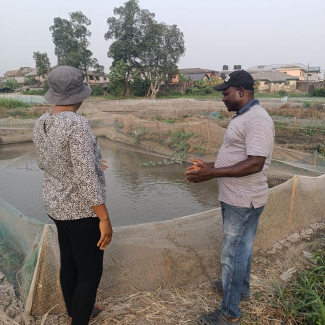
Fish farmers record 20 percent better yield one year after EfD training
Nigeria's aquaculture industry has received a significant boost, thanks to EfD Nigeria’s effort to equip local fish farmers with environmentally sustainable water management practices. Farmers from