

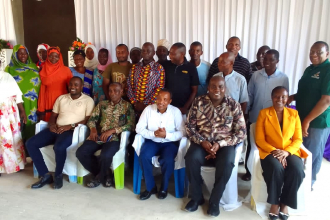
Stakeholders got training on clean cooking to fast-track a transition to clean energy
Household air pollution, mostly from using firewood for cooking, is linked to the death of around 33,000 Tanzanians annually. To facilitate a transition to clean cooking, a workshop with several…
Carbon Pricing and Firm-Level CO2 Abatement: Evidence from a Quarter of a Century-Long Panel
Will the public in emerging economies support renewable energy? Evidence from Ho Chi Minh City, Vietnam
EfD Authors:
Public acceptance and support are crucial to increasing the adoption of renewable energy technologies and establishing new renewable energy policies.
Barriers to Off-Grid Energy Development: Evidence from a Comparative Survey of Private Sector Energy Service Providers in Eastern Africa

EfD Chile researcher is recognized for conducting high-impact research
The NENRE EfD-Chile researcher, Mauricio Oyarzo, has been awarded the second edition of the Research and Artistic Creation of Excellence Award by the Vice Chancellor of Research and Development (VRID)…

“Energy is the golden thread that connects economic growth, social equity and environmental sustainability”
EfD researcher Marc Jeuland from Duke University visited EfD Uganda on December 1st. He was invited to share his work in the area of energy economics in a seminar and inspire research fellows and…
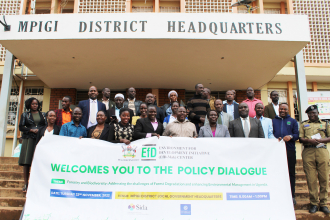
Uganda’s local governments want to decentralize governance of national forests
The Mpigi District Local Government and stakeholders in the forestry sector want environmental economists from Makerere University to conduct research on the impacts of decentralizing the governance…
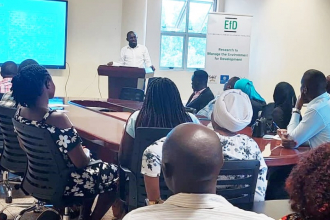
Better policies and regulations are needed to develop off-grid energy
There are several obstacles to developing off-grid energy in Eastern Africa. Those are, among others, according to a recent study by EfD Uganda, poor market information, lack of technical capacity…
Shocks derived from mining windfalls and horizontal transfers: Exploring the permanent income hypothesis in Chilean municipalities from a spatial competition approach
EfD Authors:
We explore how spatial interaction affects the strategic use of municipal income when deciding between 1) an optimal long-run expenditure strategy versus 2) using the current income to finance current activities, a phenomenon known as the permanent income hypothesis. Even when this hypothesis is grounded in temporal logic, insufficient attention has been given to the impact of spatial dependence on this type of budget decision. Therefore, we present two reasons why spatial interaction adds new insight to this discussion.