Trust, Trust Games and Stated Trust: Evidence from Rural Bangladesh
Levels of trust are measured by asking standard survey questions on trust and by observing the behaviour in a trust game using a random sample in rural Bangladesh.
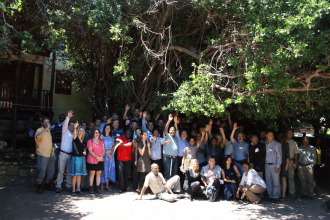

During EfD's seventh annual meeting, spring began to warm the Western Cape of South Africa creating a fertile environment for over 70 delegates to present fresh research findings and exchange…
This paper examines the adverse effect of natural resources scarcity on children's schooling and the possible gender bias of resource collection work against girls' schooling. It uses cross-sectional data on 316 children aged 7–18 years collected from 120 rural households in Tigray, northern Ethiopia. The two-stage conditional maximum likelihood estimation technique is employed to take care of endogeneity between schooling and collection intensity decisions.
A critical issue in the design of incentive mechanisms is the choice of whom to target. For forests, the leading schemes: [i] target locations with high ecosystem-service density; [ii] target additionality, i.e., locations where conservation would not occur without the incentive; or, at least effectively, [iii] reward previous private choices to conserve forest. We use a field experiment to examine the changes in contributions to forest conservation when we introduce each of those three selection rules.
Incentives conditioned on socially desired acts such as donating blood, departing conflict or mitigating climate change have increased in popularity. Many incentives are targeted, excluding some of the potential participants based upon characteristics or prior actions. We hypothesize that pro-sociality is reduced by exclusion, in of itself (i.e., fixing prices and income), and that the rationale for exclusion influences such 'behavioral spillovers'.
This is a PhD dissertation by Haileselassie Medhin and containing seven self-contained papers:
We use a natural field experiment to investigate the hypothesis that generosity is partly involuntary, by examining whether individuals tend to avoid opportunities to act generously.
We study household decision making in a high-stakes experiment with a random sample of households in rural China. Spouses have to choose between risky lotteries, first separately and then jointly.
This is a PhD dissertation by Anna Norden contains five papers: