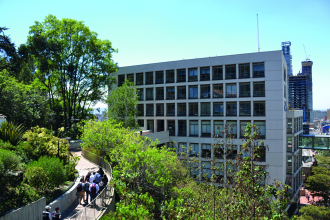
REES (Research Group on Environmental, Natural Resource, and Applied Economics Studies) hosted at the Department of Economics at Universidad de los Andes in Bogotá, Colombia

EfD Colombia center becomes a partner

The agreement between the Department of Economics at Universidad de los Andes in Bogotá, Colombia, and the University of Gothenburg ended in December 2024. The former EfD Colombia center will now be a…

| Colombia

Land tenure security and forest cover in the Colombian Amazon

Submitted by Petra Hansson on

Land tenure security (LTS) is important for achieving many sustainable development goals but its influence on forest cover is mixed. The uncertain relationship between LTS and forests is driven, in part, by the moderating influence of other drivers of deforestation. In this paper we illustrate this complex relationship between LTS and forest cover for individual private landholders in the Colombian Amazon. We use household surveys and econometric analysis with matching techniques to examine whether formal land titles and perceptions of LTS influence forest cover.

Forestry, Policy Design

Relatives, neighbors, or friends: Information exchanges among irrigators on new on-farm water management tools

Submitted by Petra Hansson on

Highlights

  • Friendship and field proximity are key determinants to information flow on new on-farm water management tools in Ethiopia.
  • Knowledge on field size and seed variety are key indicators of productive friendships in irrigation schemes.
  • Friendship and field proximity facilitate information flow on irrigation duration even among farmers without the tools.

Abstract

CONTEXT

Agriculture, Water

Shrimp farming industry in Vietnam: An aquaculture performance indicators approach

Submitted by Luat Do on

This study evaluates the Vietnamese shrimp farming industry through a Triple Bottom Line (TBL) perspective, using the Aquaculture Performance Indicators (API) to assess social, economic, and environmental performance. Over the past 25 years, Vietnamese shrimp farming has grown rapidly and diversified into four systems: Extensive, Semi-intensive, Intensive, and Super-intensive, and data is collected for all these systems.

Agriculture, Fisheries, Policy Design

Synthesis of evidence yields high social cost of carbon due to structural model variation and uncertainties

Submitted by Petra Hansson on

Estimating the cost to society from a ton of CO 2, termed the social cost of carbon (SCC), requires connecting a model of the climate system with a representation of the economic and social effects of changes in climate, and the aggregation of diverse, uncertain impacts across both time and space. A growing literature has examined the effect of fundamental structural elements of the models supporting SCC calculations. This work has accumulated in a piecemeal fashion, leaving their relative importance unclear.

Carbon Pricing, Climate Change, Policy Design