EfD researchers help lay out sustainable roadmap for colombian mining
The mining industry is vital for Colombia’s economy, but it is linked to major environmental and social challenges. EfD Colombia researchers have worked closely with the government and stakeholders for years to develop a simulation tool to address these issues and to contribute to the national mining development plan.
Around 250,000 people work directly in mining, with about one million depending on it indirectly. It generates major export revenues—coal, gold, copper, and nickel—and demand for other minerals is increasing with the green transition.
The mining industry has problems
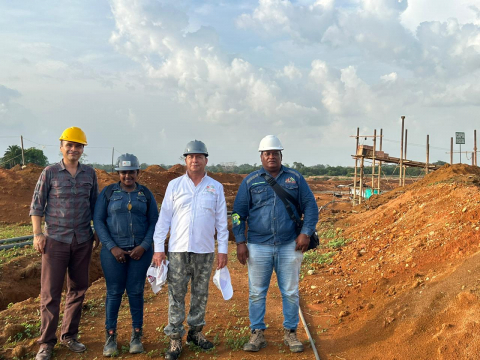
However, the sector faces serious hurdles: illegal mining, regulatory uncertainty, complex licensing, pollution, deforestation, land conflicts, and weak infrastructure. EfD researchers Santiago Arango-Aramburo, Clara Villegas-Palacio, and Carlos Saldarriaga-Isaza have studied the industry for many years. Together with colleagues from the National University of Colombia, they have collaborated closely with the Mining and Energy Planning Unit (UPME) to address these challenges.
Maria Carolina Obando Vargas at UPME highlights the importance of effective communication between researchers and policymakers. She notes that methodological rigor must align with operational realities.
Simulation tool for analysis
The first phase of the collaboration involved developing a simulation tool to explore how different policy interventions affect the environment, employment, pollution, tax revenues, and other factors. The model, covering 17 strategic minerals, combines sectoral data, expert input, secondary sources, and literature-based assumptions, projecting development pathways through 2040.
Obando Vargas says the tool has been essential for strategic analysis, emphasizing the need for high-quality data and careful handling of technical complexity.
“We had weekly and bi-weekly meetings with UPME staff for more than a year,” says Santiago Arango- Aramburo. Multi-stakeholder workshops involving policymakers, academic experts, mining representatives, environmental and social leaders, and local communities helped build a shared understanding of future challenges and opportunities.
Next step: National plan
The second phase involved contributing to the 2024–2035 National Mining Development Plan (PNDM), where the simulation tool supported prioritization. The PNDM is a comprehensive planning instrument developed with broad stakeholder participation and aims to help the Ministry of Mines and Energy achieve the goals of the National Development Plan.
The plan is now in the process of being adopted through an administrative act, which will provide the legal basis for implementation and monitoring. Key elements of the researchers’ work—simulation results, scenario analysis, and strategic recommendations—were incorporated into the official policy document, including sustainability assessments, social and environmental considerations, and pathways for critical minerals.
Lasting results
The collaboration between academia and government has produced long-lasting impacts beyond the tool and the plan. It strengthened institutional capacity in advanced policy analysis, systems thinking, and participatory modeling. It also helped integrate sustainability and inclusion into mining planning, such as considering the role of critical minerals in renewable energy, trade-offs between mining and agriculture, and alignment with territorial development needs. Emphasis on district-level planning and social dialogue contributed to more inclusive policy design.
Researchers and media joined forces to raise air pollution awareness in India
In northern India, where air pollution is a growing health crisis, researchers in collaboration with...
Rural Latin America: Scaling up climate resilience
Can climate adaptation take root in public planning, local finance, and community action...
EfD Uganda helps the government integrate natural capital in economic planning
Researchers from EfD Uganda have developed the Model for Natural Capital Policy Assessment (MONCAP)...

Elevating indigenous crops in policy and practice
EfD Tanzania researcher Dr. Innocensia John has, for years, focused on indigenous crops and their...

Research helped shape China's environmental disclosure reform
In recent years, China has taken important steps to improve environmental governance. One of the...