Researchers and media joined forces to raise air pollution awareness in India
In northern India, where air pollution is a growing health crisis, researchers in collaboration with journalists have investigated a way to raise awareness by putting science in the hands of the public through the media.
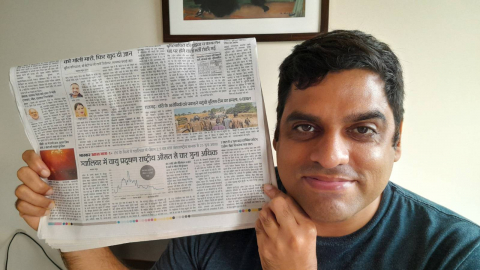
The project, Clearing the Air: The Impact of Local Media on Public Understanding of Air Quality, was led by EfD India researcher Kanishka Kacker and Martin Mattsson of the National University of Singapore. They partnered with Dainik Bhaskar, one of India’s largest regional-language newspaper networks, to publish a series of editorials in Hindi across two cities: Gwalior and Indore. Dainik Bhaskar has an average issue readership of 15 million, according to the Top 10 Hindi Newspapers in India 2025 – Most Popular List.
“Outside Delhi, many people don’t even realize how bad the air is,” said Kanishka Kacker.
“The entire northern plains are equally polluted, but the awareness isn’t there. There are signs in Delhi informing about the levels of air pollution, but most other cities don’t have that, and you often can’t feel how bad the air is.”
Editorials that educate and empower
Over the course of a month, the newspaper ran editorials three times a week in collaboration with the researchers, each week focusing on a different theme: air quality levels, health impacts, pollution sources, and practical solutions. The articles were designed to be accessible, using bullet points, graphs, and local language storytelling.
“As a responsible newspaper, our role goes beyond reporting. We strive to spark conversations that matter,” explained Satish Singh, State Editor for Madhya Pradesh at Dainik Bhaskar.
“Through this editorial initiative, we wanted to highlight that air pollution isn’t just a metro-city crisis. Cities like Bhopal, Gwalior, and Indore also face similar challenges. By bringing such issues to the forefront, our goal is not just to inform but to empower the public and encourage them to take action at their level and hold policymakers accountable,” he said.
The researchers worked closely with the newspaper’s editorial team to translate academic findings into actionable messages. Surveys conducted before and after the campaign showed a clear increase in public understanding. In cities where the editorials were published, the number of people correctly identifying indoor air quality risks rose from just over one-third to nearly half. The surveys were conducted with a QR code printed in the newspaper, and received 1,027 respondents.
From awareness to action
The campaign didn’t just inform; it also encouraged action. Readers learned how to protect themselves with masks and air purifiers and were advised to report harmful practices, such as burning garbage. The team also explored ideas like citizen helplines and community-level engagement to push for cleaner air.
While the project didn’t directly change policy, it demonstrated how media can spark bottom-up demand for environmental action.
Schools are next
Building on the encouraging results of the study, Kanishka Kacker, EfD colleagues, and associates are now expanding their work on information/ awareness as a tool to reduce air pollution problems. New research targets school children in public schools and has generated results that seriously question new Indian policies promoting air purifiers in schools. (See page 39).
EfD researchers help lay out sustainable roadmap for colombian mining
The mining industry is vital for Colombia’s economy, but it is linked to major environmental and...
Rural Latin America: Scaling up climate resilience
Can climate adaptation take root in public planning, local finance, and community action...

EfD Uganda helps the government integrate natural capital in economic planning
Researchers from EfD Uganda have developed the Model for Natural Capital Policy Assessment (MONCAP)...

Elevating indigenous crops in policy and practice
EfD Tanzania researcher Dr. Innocensia John has, for years, focused on indigenous crops and their...

Research helped shape China's environmental disclosure reform
In recent years, China has taken important steps to improve environmental governance. One of the...