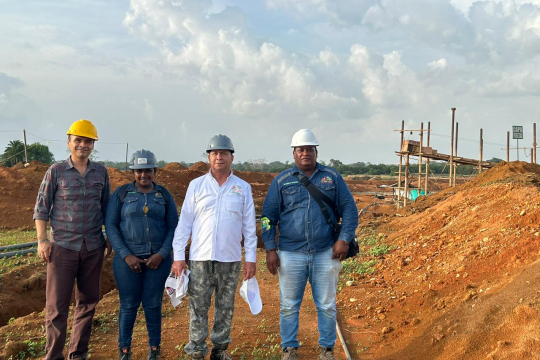
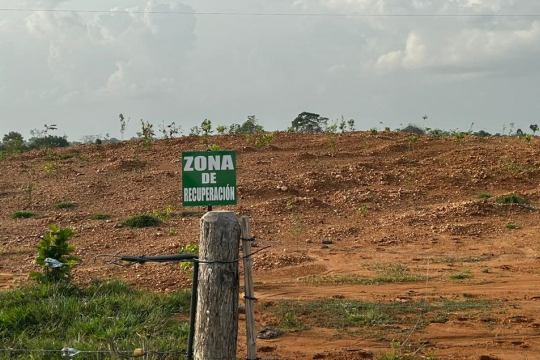
The mining industry is a vital source of economic development in Colombia. It’s also connected with significant environmental and social challenges. EfD Colombia researchers have worked closely with the government and stakeholders for years to develop a tool for simulations to address those challenges and contributed to the development of the national mining development plan.
Around 250,000 people work in the mining industry in Colombia, with about one million indirectly depending on it. It’s a major source of export revenues, for instance, coal, gold, copper, and nickel, and now, with the goal of a green transition, there is an increasing demand for other minerals as well.
The mining industry faces problems
However, the mining industry also faces major hurdles, including illegal mining, regulatory uncertainty, complex licensing processes, pollution, deforestation, land conflicts, and weak infrastructure.
EfD researchers Santiago Arango-Aramburo, Clara Villegas-Palacio, and Carlos Saldarriaga-Isaza have conducted research on the mining industry for many years. They have, along with colleagues from the National University of Colombia, collaborated closely with the Mining and Energy Planning Unit (UPME) at Colombia’s Ministry of Mines and Energy to address those challenges.
Simulation tool - instrumental for analysis
Maria Carolina Obando Vargas at UPME was one of the leading participants in the project. She underlines the importance of close collaboration between researchers and policymakers:
“I believe that collaboration with researchers is essential to combine methodological and technical perspectives with a scientific vision," she says.
"However, researchers tend to prioritize idealized approaches. When such academic theories meet operational reality, discrepancies may arise that require in-depth discussions to reach consensus. Therefore, communication is the most critical factor.”
The first phase of the collaboration included developing a tool to simulate scenarios for the mining industry, that is, how different policy interventions will affect the environment, employment, pollution, tax revenues, and other factors. The tool was designed to explore alternative development trajectories for the mining sector through 2040. The model covers 17 strategic minerals and combines data from different sectors, expert input, secondary sources, and literature-based assumptions.
Tool was key to analyzing strategic issues
Obando Vargas concludes that the tool has been key to analyzing strategic issues. It has, among other things, highlighted the importance of using high-quality data as input and taking into consideration the technical complexity of many related variables.
“We had weekly and bi-weekly meetings with the UPME staff for more than a year to develop the simulation model,” says Santiago Arango-Aramburo.
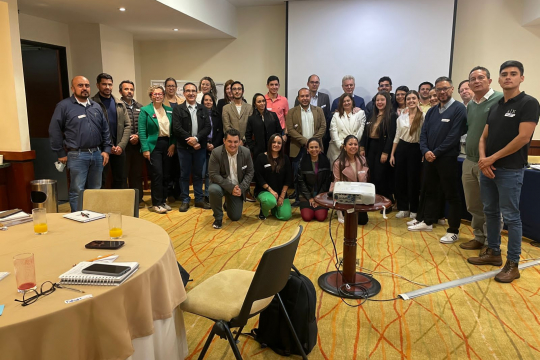
“In addition, we had a series of multi-stakeholder workshops throughout the project period, with policymakers, academic experts, mining representatives, environmental and social leaders, and local communities, which helped build a shared understanding of future challenges and opportunities.”
Next step: National plan
The second phase was participating in the elaboration of the 2024–2035 National Mining Development Plan (PNDM) where the simulation tool was used to provide input and help make prioritizations.
The PNDM is a comprehensive planning tool for the development of mineral resources. It’s been formulated in collaboration with stakeholders to allow for broader ownership of the plan. It aims to support the Ministry of Mines and Energy in achieving the goals of the National Development Plan.
Lasting results
Currently, the plan is in the process of being adopted through an administrative act, which will provide the legal foundation for its effective implementation and monitoring.
Key components of the researchers’ work, including the simulation model, scenario results, and strategic recommendations, were used as official inputs in the national policy document. These include sustainability assessments, social and environmental considerations, and policy pathways for critical minerals.
This collaboration between academia and government has also led to impacts beyond the simulation tool and the National Mining Development plan. The collaboration between the Universidad Nacional de Colombia and UPME has helped build institutional capacity in advanced analysis and design of mining policy, systems thinking, and participatory modeling.
It also contributed to include sustainability and inclusion in mining planning, for instance, the role of critical minerals for renewable energy, the trade-offs between mining and agriculture, and aligning mineral planning with territorial development needs. Emphasis was placed on district-level mining planning and social dialogue with local communities, contributing to more inclusive policy design.
By: Petra Hansson
Academic publications
- Arango-Aramburo, S., Smith, R., Jaramillo, P., Olaya, Y., Saldarriaga, A., Restrepo, O. J., … & Larsen, E. R. (2020). In search of a future for mining: participative scenarios for Colombia. Journal of Sustainable Mining, 19(2).
- Arango-Aramburo, S., Jaramillo, P., Olaya, Y., Smith, R., Restrepo, O. J., Saldarriaga, A., … & Larsen, E. R. (2017). Simulating mining policies in developing countries: The case of Colombia. Socio-Economic Planning Sciences, 60, 99–113.
- Arango-Aramburo, S., Olaya, Y., & Restrepo, O. J. (2024). Modeling sustainable mining futures in Colombia. Manuscript submitted for publication (under review). evaluating the impacts of proposed interventions.
- Arboleda, Y., Congote, D., Flechas, L., Vásquez, M. P., & Aramburo, S. (in preparation). Integrating socio-environmental metrics into mining-sector scenario planning. Manuscript in preparation. A working paper (in progress) that will incorporate social and environmental indicators into the simulation framework. Once complete, it will demonstrate how EfD tools can inform comprehensive policy design for Colombia’s mining future.