NENRE meeting

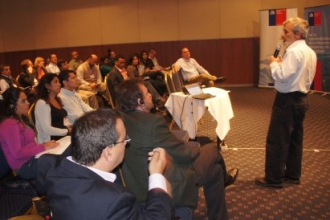
Call for Papers and Policy Works: NENRE-EfD Chile 7th meeting in October! (in Spanish)

Submit your work here: https://bit.ly/3x8uh34 The Seventh Annual Meeting of the EfD Chile center "Research Nucleus on Environmental and Natural Resource Economics (NENRE)", will take place on October…

Date: Thursday 14 — Friday 15 October, 2021
Location: Virtually

Distributional justice and hydropower development: A case study of Chile's equity tariff scheme

Submitted by Cristóbal Vásquez on

Implementing hydropower projects requires understanding community acceptance, especially regarding equity tariff schemes. This study assesses an equity tariff scheme as a compensation mechanism for accepting new hydropower projects by considering reducing local electricity tariffs while increasing in non-electricity-generating communities. We consider two scenarios involving a small-medium hydropower project (up to 100 MW) in Southern Chile: one in a zone with existing hydropower plants and another without previous hydropower experience but with high potential.

Energy, Water

Economic Impacts of Droughts on Agriculture and Urban Water Supply Sector

Submitted by Cristóbal Vásquez on

This chapter explores the economic effects of long-term droughts on agriculture and urban water supply sectors in Chile, with a particular focus on the ongoing megadrought that started in 2010. Using a comprehensive framework that incorporates Infrastructure Capacity (IC), the Amount of Water in Storage (AWS), and adaptation strategies, we offer a detailed analysis of resilience mechanisms and the economic impacts of drought conditions.

Agriculture, Water

Price Elasticity of the Residential Water Demand in Latin America: Empirical Analysis for Chile, Colombia, and Peru

Submitted by Cristóbal Vásquez on

The Latin American region lacks information on residential water demand and its price elasticity, in contrast to the extensive literature available in developed countries. To address this gap, we estimate residential water demand and its price elasticity in Chile, Colombia, and Peru using a discrete-continuous choice (DCC) model that accommodates nonlinear increasing block tariff (IBT) structures. We utilize household-level datasets for Peru and Colombia and a large administrative panel in Chile.

Water

Removing rationing: Power consumption and groundwater monitoring in South India

Submitted by Arnaaz Zaman on

In most Indian states, electricity for irrigation is unmetered but rationed through limited daily supply hours. This study estimates the impact of the 24-hour agricultural electricity policy implemented in Telangana state in 2018, which effectively removed this rationing.

Agriculture, Climate Change, Policy Design, Water