

EfD and MCC will host side event at COP28
EfD and MCC will jointly host a side event at COP28 in Dubai. The event, which features an impressive line-up of speakers, will focus on carbon pricing and how it affects different social groups…
Policy Nook — Policy Note: Benefit Cost Analysis of Water Investments in the Anthropocene
EfD Authors:
Introduction
Water management is becoming increasingly challenging. The core problem in many locations is an old one: water scarcity will increase as demand rises due to population and economic growth. Conditions in the modern Anthropocene — higher temperatures, continental drying, higher evaporation, and non-stationary hydrology — will add complexity.

Can revenue recycling make fossil fuel subsidy reform and carbon tax socially acceptable? A survey experiment in Colombia
Carbon pricing needs to be a cornerstone policy to reach the Paris Climate Agreement. A common concern for introducing even moderate adjustments to prices is related to the possible adverse (or
Policy options for employment intensive and low emissions development in South Africa
EfD Authors:
Introduction South Africa has the dubious distinction of having amongst the highest rates of unemployment and inequality in the world. It is also one of the most emissions-intensive economies, measured in greenhouse gas (GHG) emissions per unit of economic output. The co-existence of high unemployment and high emissions intensity is not just a coincidence. South Africa’s history of segregation and apartheid has had profound implications for its development path. One outcome was an economy heavily based on mining, mineral processing and heavy industry, subsidised by cheap electricity.
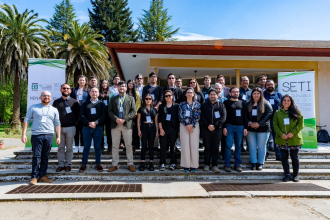
EfD Chile's 9th Annual Meeting addressed environmental challenges
EfD Chile hosted its Ninth Annual Meeting in Villa Baviera Parral, Chile, where researchers, policymakers, and students converged on October 19 and 20 to tackle various pressing environmental issues…
EEU Seminar - Anjali Ramakrishnan
Anjali Ramakrishnan is a Researcher in the project on Inclusive Green Transitions for Sustainable Development in the Global South, based at the EfD Global Hub. In this seminar Anjali will present her…
Call for Paper: NESS 2024
The 16th Nordic Environmental Social Science Conference, hosted by Åbo Akademi University in cooperation with the University of Turku, Finland, calls scholars for meeting and discussing current…
Public services, environmental quality and subjective well-being in a European city: the case of Strasbourg metropolitan area
EfD Authors:
This paper analyzes individual subjective well-being using a survey database from the Strasbourg metropolitan development council (France). The authors focus on the effects of externalities generated by public services (transport, culture and sport), environmental quality and feeling of security in the Strasbourg metropolitan area (Eurométropole de Strasbourg, EMS). Results show that EMS specificities (public facilities, environmental quality, safety and security) and individual features like opportunities to laugh or live with children significantly influence individual well-being.