

The pollution haven strikes back?–Evidence from air quality daily variation in the Jing-Jin-Ji region of China
EfD Authors:
Pollution havens create environmental inequality issues. China’s recent policy of directing high-pollution firms to migrate out of its capital, Beijing, offers a case of a pollution haven that was mandated, rather than resulting from firms’ responses to environmental regulation. More importantly, it leads to a question that has been less discussed in previous literature: does a pollution haven strike back?
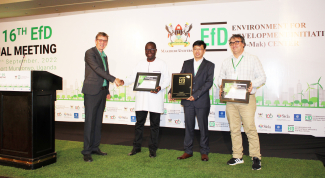
Three win the EfD Policy Impact Award during the 16th EfD Annual meeting in Uganda
Three research teams were on 25th September 2022 awarded the EfD Policy Impact Award during the 16th EfD Annual meeting held at the Speke Resort Hotel Munyonyo Kampala Uganda. The award is to
China's unconventional nationwide CO2 emissions trading system: Cost-effectiveness and distributional impacts
China is implementing what is expected to become the world's largest CO2 emissions trading system. To reduce emissions, the nation employs a tradable performance standard (TPS), a rate-based instrument differing significantly from cap&trade (C&T) and a carbon tax, emissions pricing instruments used elsewhere. With matching analytically and numerically solved models, we assess the cost-effectiveness and distributional impacts of China's TPS for reducing CO2 emissions from the power sector.

Forest dependence in Tanzania: Analysis of the determinants of perceived forest dependence
EfD Authors:
Abstract
Great hopes have been placed on devolution policies as a means of attaining sustainable forest management in developing countries.
Scaling smallholder tree cover restoration across the tropics
EfD Authors:
Restoring tree cover in tropical countries has the potential to benefit millions of smallholders through improvements
in income and environmental services. However, despite their dominant landholding shares in many
countries, smallholders’ role in restoration has not been addressed in prior global or pan-tropical restoration
studies. We fill this lacuna by using global spatial data on trees and people, national indicators of enabling
conditions, and micro-level expert information. We find that by 2050, low-cost restoration is feasible within 280,
Forest fires and impacts of COVID-19 lockdowns on air quality in four Latin American megacities


Economist with a passion for snow leopards and ecosystems defended thesis
Shi Xiangying, one of the many excellent doctoral students at EfD China who obtained their Ph. D.s this summer, is dedicated to the research of ecosystem equilibrium and the conservation of snow