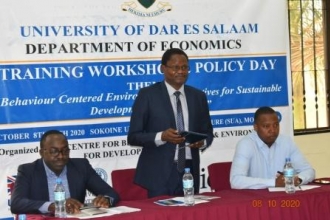
Tanzania policy makers and researchers descended into Morogoro town for two days of training and interaction on sustainable development
Environment for Development (EfD) Tanzania together with the Centre for Behavioral Studies (CBS) held a two-day (8th-9th September 2020) workshop for the purpose of policy interaction and training…
Assistant Professor Environmental and Natural Resource Economics (Tenure Track Position)
The Environmental Economics and Natural Resource Group (ENR) at Wageningen University and Research (WUR) is looking for a Assistant Professor to join their team. The applicants must have completed a PhD in economics with a focus, or at least a strong interest on environmental issues. We have a preference for strong quantitative empirical skills (e.g.
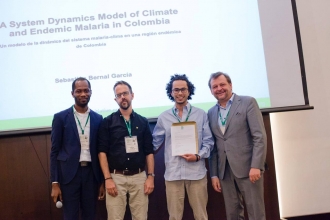
Passion drives last year’s winner of Gunnar Köhlin’s Award
EfD’s Annual Meeting is approaching and the award jury is busy evaluating all the qualified nominees for Gunnar Köhlin’s Best Master Thesis Award. In the meantime, let’s meet last year’s winner…
Blue Resources for Development (BlueRforD)
Vision |
|
The main objective of this program is to contribute to increased knowledge regarding the development of sustainable capture fisheries, aquaculture, and marine spatial planning, and their links to blue growth, food security, and poverty alleviation. |
Areas of Contribution |
|
The Marine program has methodologies and applications regarding |
CO2 emissions, agricultural productivity and welfare in Ethiopia
EfD Authors:
Purpose – Climate change has become one of the most important development challenges worldwide. It affects various sectors, with agriculture the most vulnerable. In Ethiopia, climate change impacts are exacerbated due to the economy’s heavy dependence on agriculture. The Ethiopian Government has started to implement its climate-resilient green economy (CRGE) strategy and reduce CO2 emissions. Therefore, the purpose of this study is to examine the impact of CO2 emission on agricultural productivity and household welfare.
Games as boundary objects: charting trade-offs in sustainable livestock transformation
EfD Authors:
Attempts to structurally transform segments of the agri-food system inevitably involve trade-offs between the priorities of actors with different incentives, perspectives and values. Trade-offs are context-specific, reflecting different socio-economic and political realities. We investigate the potential of structured boundary objects to facilitate exposing and reconciling these trade-offs within the context of multistakeholder social learning processes with pastoral and mixed crop-livestock communities in Burkina Faso, Ethiopia and Tanzania.
Designing sustainable pathways for the livestock sector: the example of Atsbi, Ethiopia and Bama, Burkina Faso
EfD Authors:
Demand for animal sourced food is predicted to double in the upcoming 20 years in Sub-Saharan Africa. This is simultaneously a big opportunity in terms of poverty reduction and a significant threat to the environment. The objective of this paper is to present an approach to co-create a set of viable and acceptable development pathways for the livestock sector that maximizes benefits from increased production, exploits the synergies between livestock and the environment, while minimizing the negative effects.
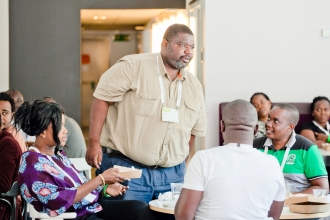
Meet last year’s winner of the Best Discussion Paper Award
One of the highlights of EfD’s Annual Meeting, is the announcement of the winner of the Best Discussion Paper Award. Last year’s winner says the award was not only a great recognition but also…