Managing Climate Change in Post COVID-19 Nigeria
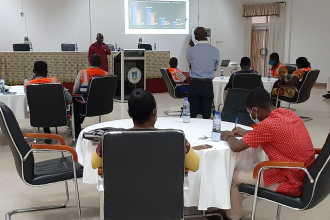
A Webinar and Dialogue on Managing Climate Change in Post COVID-19 Nigeria: Policy Options for Low-Carbon Climate Resilient Development Registration Coming Soon
Reduction of post-harvest loss (PHL) can play an important role in complementing efforts to address food security challenges. This paper used data from 390 small-scale maize farmers in Kilosa, Tanzania to analyse the impact of post-harvest management training and the supply of hermetic bags on food insecurity status in a framed field experiment setting with two treatments.
When prediction intervals are constructed using unobserved component models (UCM), problems can arise due to the possible existence of components that may or may not be conditionally heteroscedastic. Accurate coverage depends on correctly identifying the source of the heteroscedasticity. Different proposals for testing heteroscedasticity have been applied to UCM; however, in most cases, these procedures are unable to identify the heteroscedastic component correctly.
Air pollution, particularly PM2.5 particulate matter, is a significant issue in Santiago, the capital of Chile. Santiago’s pollution problem is exacerbated by its unique geographic location nestled against the Andes mountain range in the central valley of Chile. This paper uses network models that were developed primarily to analyze systemic risk in the financial system to identify those locations in the city that are most important for explaining PM2.5 levels.
The Fisheries Performance Indicators is a data collection tool that allows comparable fisheries data in the environmental, economic and community dimensions to be collected even in data-poor environments. In this paper, data collected for 35 fisheries in 14 African countries that make up 54.8% of Africa’s reported fish landings are analyzed and compared to global averages. Similar to a previous global analysis, our results indicate no trade-offs between the different pillars of sustainability, as all are positively correlated.
This paper contributes to the growing literature on energy poverty in developing countries. We use a dynamic probit estimator on three rounds of panel data from urban Ethiopia to estimate a model of the probability of being energy poor and to investigate the persistence of energy poverty. We also study the impact of energy price in!ation,which Ethiopia experienced during 2007–2009, on energy use and energy poverty.We"nd strong evidence of state dependence in energy poverty. A household that is energy poor in one round is up to 16% more likely to be energy poor in the subsequent round.
In this paper we discuss the choice of taxation or regulation of environmental externalities. The subject might appear to be a well-trodden path, but we believe we have a new angle on this well-established question. We think we are being quite realistic when we assume that corrupt practices lurk behind every corner, threatening to derail the good intents of any regulator.