Modeling tool can improve funding allocation for ecosystem services
A team of EfD Central America researchers provided a training titled Monitoring the provision of ecosystem services using InVEST to make decisions. The aim was to strengthen the capacities of the…
EfD Chile researchers discussed local environmental policy with politicians and other stakeholders
The Eigth Annual Meeting on Environmental Economics was marked by face-to-face attendance and included the participation of representatives from the academic, political, business, and civil society…
EfD Uganda launches two projects regarding the National Water and Forest Authorities
The Environment for Development Initiative (EfD) Makerere Centre has launched two new collaborative projects, one on improving the National Water Authority’s water bill payments and one analysis of…
Three win the EfD Policy Impact Award during the 16th EfD Annual meeting in Uganda
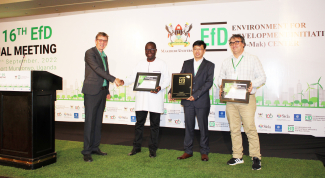
Three research teams were on 25th September 2022 awarded the EfD Policy Impact Award during the 16th EfD Annual meeting held at the Speke Resort Hotel Munyonyo Kampala Uganda. The award is to
What matters in adoption of small-scale rain water harvesting technologies at household level? Evidence from Charco-dam users in Nzega, Tanzania
Abstract
Any effort to improve irrigation water availability has an advantage in the crop production processes. Small-scale rainwater harvesting technologies like Charco-dams (Malambo) in Swahili (the language used by most the Tanzanians) are among the interventions proven to overcome agricultural water shortage.
Opportunities and challenges for small-scale aquaculture in southern Chile: The stakeholders’ perspective
We identify and explore the potential opportunities and challenges for promoting and expanding small-scale aquaculture (SSA) as an additional income-generating activity for coastal communities in southern Chile. Based on a conceptual model of SSA adoption decisions, we conducted field key informant semistructured interviews with stakeholders in the Los Lagos region and in the regional capital city, Puerto Montt. We conducted a qualitative analysis of the interviews to identify potential resource users’ perceptions of current SSA opportunities.
Stakeholders discuss ways to reduce plastic pollution in the oceans
Plastic pollution of marine ecosystems is a global problem with severe consequences for wildlife and economic activity. The Sustainable Seas Trust (SST) hosted the second International Conference of…
Economics of Marine Protected Areas: Assessing the Literature for Marine Protected Area Network Expansions
Marine protected areas (MPAs) provide both conservation and economic benefits. Recent international conservation actors have called for a dramatic increase in the area of MPAs from almost 8% to 30% of marine area by 2030 in a policy called 30X30. Both the economics and conservation science literature consider MPA decisions and MPA impact, although the economics literature focuses on fishery economic outcomes. This review uses an optimization framework for MPA decisions as a lens through which to evaluate the economics literature on MPAs in the context of the 30X30 expansion decisions.
Pagination
- Previous page
- Page 15
- Next page