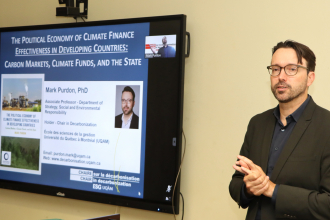
“Carbon prices too low to cut emissions”
Climate policy expert and EfD Associate Professor Mark Purdon warns that current carbon pricing mechanisms are insufficient to drive meaningful reductions in emissions in developing countries. He…

Climate policy expert and EfD Associate Professor Mark Purdon warns that current carbon pricing mechanisms are insufficient to drive meaningful reductions in emissions in developing countries. He…
Phasing out fossil fuel subsidies is a politically sensitive yet urgent climate challenge. In Colombia, these subsidies create a significant fiscal burden and hinder the transition to cleaner energy
Asia’s continued and rapid increase in energy demand underscores the need for the decarbonization of energy systems in the region. Concurrently, it is imperative to facilitate a just transition that can foster the support from citizens. This requires research that incorporates the perspectives of citizens regarding the various alternatives and pathways. This Special Feature offers novel insights into public preferences regarding renewable energy in urban areas in Southeast Asia, East Asia, and Japan, as well as emerging technologies to address climate change in the region.
The European Union (EU)'s Carbon Border Adjustment Mechanism (CBAM) imposes import charges tied to carbon intensity and is set for full enforcement by 2026. Although it aims to reduce global emissions, its one-size- ts-all structure risks penalizing developing nations that often lack nancial and technical resources for rapid decarbonization. This article presents CBAM-Plus, a framework that reinvests CBAM revenues in clean energy infrastructure, facilitates technology transfer, and recognizes non-pricing mitigation strategies.
Decarbonizing the power sector and the transition to a low-carbon energy future are critical strategies for reducing emissions.
ABSTRACTGlobal fish consumption has increased substantially over the past six decades, with aquaculture surpassing wild catches in 2022. This growth has raised concerns about environmental sustainability and food safety, prompting the use of eco‐labels to inform consumers about sustainable practices. This study employed a discrete‐continuous choice experiment method to investigate consumer demand for sustainably produced shrimp in Vietnam, focusing on the influence of eco‐labels on purchase decisions.
Purpose
The contributions of gender equality to trade and the moderating impact of institutional quality on the trade-gender link have been understudied in contemporary literature. Therefore, this paper aims to use the augmented gravity model to investigate the impacts of gender equality and institutional quality on trade, and the moderating impact of institutional quality on the trade-gender link.
ABSTRACTIn a comprehensive study across 32 Asian countries and territories spanning 2002–2018, we unveil the surprising impact of uncertainty on income inequality. Contrary to conventional expectations, our analysis reveals a fascinating trend: heightened uncertainty appears to wield a dual impact on income distribution. While it diminishes the income shares of both the richest and the poorest segments of society, the reduction is far more pronounced among the wealthiest quintile. Surprisingly, this outcome leads to a lessening of income inequality.