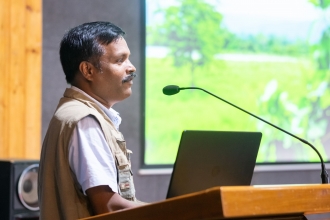
CECFEE Annual Policy Day 2019
CECFEE held its 2nd Policy Day on 10th November, 2019 by organizing a discussion on conservation of forest resources and wildlife. The key speaker for this event was Mr. P.Sivakumar, IFS, Director of…
CECFEE held its 2nd Policy Day on 10th November, 2019 by organizing a discussion on conservation of forest resources and wildlife. The key speaker for this event was Mr. P.Sivakumar, IFS, Director of…
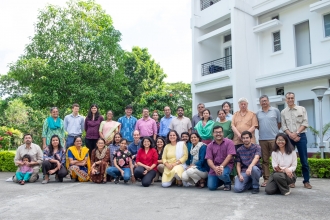
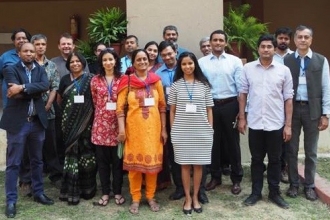
CECFEE hosted its 5th Annual Workshop at the University of Tezpur, Assam. The workshop spanned two days, 10-11 November 2019, and brought together an eclectic mix of researchers and academics. Broadly…

The Center for research on the Economics of Climate, Food, Energy and Environment (CECFEE) of the Indian Statistical Institute, New Delhi, will conduct the 4th Annual CECFEE Research and Policy…
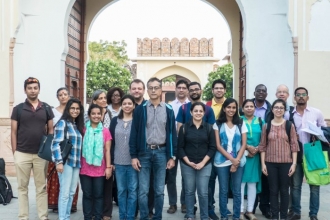
A workshop was organized by the Centre along with the Environment for Development Initiative (EFD) of the University of Gothenburg on October 15th and 16th at Ranthambhore. There were presentations…
AGENDA Monday, November 2, 2015 Morning Introduction and Welcome – E. Somanathan About EfD – Gunnar Kohlin, University of Gothenburg Credit, LPG Stove Adoption and Charcoal Consumption: Evidence from…
Biomass burning of agricultural field residue (stalks and stubble) during wheat and rice harvesting periods in the Indo-Gangetic plains has led to substantial emission of trace gases and particles. This paper seeks to address the regulation of emissions from open field burning of rice residue in Punjab, India by first uncovering the factors that explain on field residue burning of rice residue in Punjab. The results suggest that the use of a combine harvester was the single most important determinant of the decision to burn rice residue.
Hotter years are associated with lower economic output in country-level data. We show that the effect of temperature on labor is an important part of the explanation. Using high-frequency micro data from selected firms in India, we find that worker productivity on hot days declines by 2 to 4 percent per degree celsius. Sustained heat also increases worker absenteeism.
It is well-recognized that new technology is a crucial part of any solution to the problem of climate change. But since investments in research and development take time to mature, price and quantity instruments, i.e., carbon taxes and cap-and-trade, run into a commitment problem. We assume that the government cannot commit to the level of a policy instrument in advance, but sets the level to be optimal ex-post.
Farmers’ risk preferences play an important role in agricultural production decisions. This study characterizes risk preferences among farmers in Yongqiao and determines how these risk preferences are related to their choices regarding climate change adaptation strategies. We find that most farmers in the study area were aware of climate change. They were taking measures to protect their livelihoods against perceived changes to the local climate. The risk experiment result shows that the representative subject was risk averse, and women were more risk averse than men.