
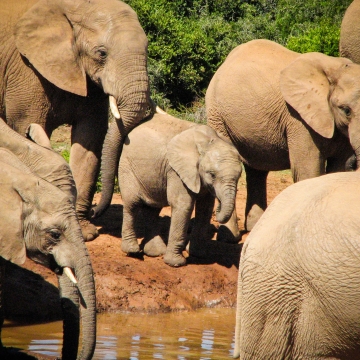
Deriving a Benefit Transfer Function for Threatened and Endangered Species in Interaction with Their Level of Charisma
EfD Authors:
Biodiversity and species conservation are among the most urgent global issues. Both are under serious threat because of human intrusion and as a result, it is likely that present and future projects will affect threatened and endangered species. Thus, it is important to account for these impacts when evaluating and conducting cost and benefit analyses of projects.

Byela Tibesigwa: the Snowball Effect
Dr Byela Tibesigwa’s career is the result of what she calls a snowball effect. She did her doctorate in Cape Town, South Africa, where she came in contact with the Environment for Development (EfD)


Francisco Alpízar: Conservation and Capacity Building Dream for Latin America
As an eco-wonderland, Costa Rica and Latin America have a staggering amount of biodiversity and many unspoiled natural wonders. Over a quarter of the land in Costa Rica is protected from potential
Status and trends in global primary forest, protected areas, and areas designated for conservation of biodiversity from the Global Forest Resources Assessment 2015
EfD Authors:
The global community has recognized the importance of forests for biodiversity, and has prioritized the preservation of forest biodiversity and ecosystem functions through multiple multilateral agreements and processes such as the Convention on Biodiversity’s Aichi Targets and the Millennium Development Goals. The Global Forest Resources Assessment (FRA) provides one mechanism for tracking progress toward such goals in three particular areas: primary forest area, protected forest areas, and areas designated for the conservation of biodiversity.
Summary for Policymakers of the Assessment Report on Biodiversity and Ecosystem Services for Asia and the Pacific
EfD Authors:
The Regional Assessment Report on Biodiversity and Ecosystem Services for Asia and the Pacific produced by the Intergovernmental Science-Policy Platform on Biodiversity and Ecosystem Services (IPBES) provides a critical analysis of the state of knowledge regarding the importance, status, and trends of biodiversity and nature’s contributions to people. The assessment analyses the direct and underlying causes for the observed changes in biodiversity and in nature’s contributions to people, and the impact that these changes have on the quality of life of people.
Biodiversity/ecosystem services scenario exercises from the Asia–Pacific: typology, archetypes and implications for sustainable development goals (SDGs)
EfD Authors:
This paper presents a systematic review of biodiversity/ecosystem services scenario exercises from the Asia–Pacific region. From the limited scholarly literature available, 61 scenario exercises were examined to explore their typology and multiple scenario attributes, including geographic distribution, consideration for influential drivers, choices of ecosystem services, number of alternative futures and temporal horizons for scenario deployment.
Policy Dialogue with Mukono District Leadership
Environmental Economists from the Environment for Development-Makerere University (EfD-Mak) Centre on 20th February 2020 conducted a policy tour of Mukono District Local Government headquarters where
Environmental economists Conduct Policy Tour to Wakiso district
Environmentalist and economists from Environment for Development Initiative (EfD– Mak Centre) set out from the Ivory Tower to Wakiso district headquarters to dialogue with the councilors on the