




Livestock and Private Tree Holdings in Rural Ethiopia: The Effects of Collective Action Institutions, Tenure Security and Market Access
EfD Authors:
This article uses househld panel data spanning the period 2000–2007 to test hypotheses from the literature that secure land tenure, market access and collective action promote accumulation of private capital assets in rural highland Ethiopia. The three natural capital assets analysed in the article, livestock, eucalyptus trees and non-eucalyptus trees on households’ farm plots, make up virtually 100 per cent of privately held disposable assets. Incomes and capital stocks are extremely low and constant and tree assets are at least as important as livestock.
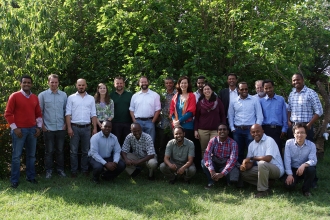
High profile Energy Workshop in Ethiopia completed
A workshop, titled ‘Sustainable energy transitions in low and middle-income countries: lessons for Ethiopia’ was held on June 1 st to 3 rd in Ethiopia to explore the potential for a new EfD research…
EfD Annual report 2014/15
The EfD Report 2014/15 gives you an excellent overview of the EfD centres´ achievements during 2014 and ongoing work during 2015. Ranging from interesting policy stories on how economic research is put to use around the world to collaborative research programs, a wide range of publications, and our academic capacity building program.
Climate change and the Ethiopian economy: a CGE analysis
EfD Authors:
The paper analyzes the economic impacts of climate change-induced fluctuations on the performance of Ethiopia's agriculture, using a countrywide computable general equilibrium (CGE) model. We model the impacts on agriculture using a Ricardian model, where current agricultural production is modelled as a function of temperature and precipitation, among other things, and where future agriculture is assumed to follow the same climate function. The effect of overall climate change is projected to be relatively benign until approximately 2030, but will become considerably worse thereafter.

Understanding gender relations crucial when dealing with the ”killer in the kitchen”
Effective kitchen stoves that use less firewood and emit fewer greenhouse gases are both cheap and available to the rural population in many developing countries. But the demand for the stove is low…