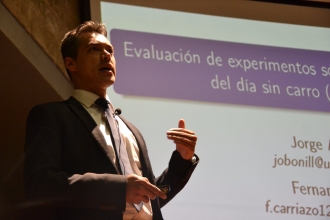
A Contingent Valuation Approach to Estimating Regulatory Costs: Mexico’s Day Without Driving Program
Little is known about the cost of environmental regulations such as residential zoning restrictions and recycling mandates that target households instead of firms, partly because of significant methodological and data challenges. We use a survey-based approach, the contingent valuation method, to measure the costs of Mexico City’s Day Without Driving program, which seeks to stem pollution and traffic congestion by prohibiting vehicles from being driven one day each week.
Behavior change will improve air and public health
Air pollution caused by wood-burning in homes for cooking and heating purposes is one of the most important environmental problems in Chile, affecting thousands of families and causing early mortality
Greener Industry If Environmental Authorities Change Strategy
Fewer industrial firms would violate environmental legislation and a higher number would adopt cleaner technologies if environmental authorities would focus their monitoring efforts on companies with…
‘Best practice’ for development-focused eco-tourism on the cards
How can tourism operators and nature conservationists leverage the most eco-tourism benefits for communities living on the borders of protected areas and conservancies? This is the motivating question…
Community buy-in and conservancies: a Southern African perspective
Development-focused eco-tourism partnerships between local communities and private enterprises are more likely to succeed if the communities living on the edge of protected areas are able to make
Competition Commission takes on SA fishing industry
The Competition Commission has urged the South African government to revisit the fishing rights allocation process in a way that will counter what it perceives as entrenched anti-competitive behaviour…
Environmental and Economic Impacts of Growing Certified Organic Coffee in Colombia
According to advocates, eco-certification can improve developing country farmers’ environmental and economic performance. However, these notional benefits can be undercut by self-selection: the tendency of relatively wealthy farmers already meeting eco-certification standards to disproportionately participate.
NENRE renewed support from the Chilean Government
Membership of a well-reputed international environmental economics research and capacity building network such as the EfD initiative was among the criteria when the Chilean EfD Center, the Research…
Ecosystems in focus for research collaboration in 8 EfD countries
In decision making all over the globe there tends to be a disregard of the contribution that ecosystem services make to human wellbeing. Eight EfD Centers are the key implementing partners in the new…