| Air Quality, Climate Change, Health | India

The difficult choice of a cooking fuel

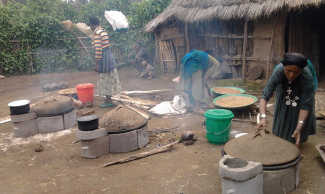
Indoor air pollution is a major problem in the developing world and. Most of these emissions are generated while cooking with solid fuels. For this reason, understanding the determinants of LPG (Liquefied Petroleum Gas) stove adoption in rural India is key for designing good policies. This column looks at the impact of electrification on the choice of cooking fuel. According to the energy ladder theory, the increase in socioeconomic status generated by electrification should push households towards the adoption of cleaner cooking fuels.

erceived Community Resilience to Floods and Droughts Induced by Climate Change in Semi-arid Ghana

Submitted by Vicentia Quartey on
EfD Authors:

Droughts and floods are some of the major climatic hazards in the semi-arid areas of Sub-Saharan Africa (SSA). Climate change affects the periodicity and severity of such hazards, and eventually the well-being of many rural communities in the region, including semi-arid Ghana. Enhancing the resilience of local communities to droughts and floods would be a necessary step to meet different national development priorities. The aim of this chapter is to assess the perceived community resilience to recurrent floods and droughts induced by climate change.

Climate Change

The effect of adaptive capacity to malaria on subjective welfare in Ghana

Submitted by Vicentia Quartey on
EfD Authors:

There is a significant correlation between ​climate variability and the incidence of climate-sensitive diseases such as malaria. This has implications for the welfare of households affected by malaria especially in resource-poor communities. Vulnerability and resilience underpin adaptive capacity to malaria, hence understanding the relationship between the latter and welfare is critical for social welfare policy formulation.

Climate Change, Health

Households' socio-demographic characteristics, perceived and underestimated vulnerability to floods and related risk reduction in Ghana

Submitted by Vicentia Quartey on
EfD Authors:


Highlights

  • Studies assessing households' vulnerability to floods significantly ignore the element of underestimation.
  • The concept of “Perceived Vulnerability” enhances the value of assessing flood risks.
  • Gender differences of household heads exist in Perceived Vulnerability to urban floods.
  • Age among male household heads determined underestimation of floods although non-linear.
    Climate Change, Urban