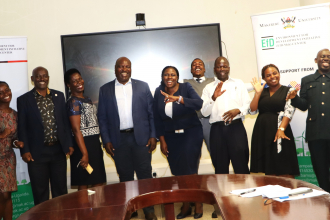
Uganda inaugurates 2025–2026 cohort for Inclusive Green Economy Program
Kampala, Uganda – April 15, 2025 — Uganda has officially launched the 2025–2026 cohort of the Inclusive Green Economy (IGE) in Practice Capacity Building program, a regional initiative aimed at…
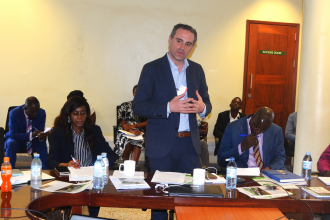
EfD engages World Bank in regional climate-sensitive macroeconomic modelling hub
A new Regional Centre of Excellence in Climate-Sensitive Macroeconomic Modelling will position Makerere University at the forefront of Africa’s climate and economic policy landscape. Hosted at the EfD…

Championing Uganda’s Green Economy: Insights from Nathan Mununuzi
Nathan Mununuzi serves as a Senior Environmental Officer at Uganda’s Ministry of Water and Environment. A participant in the Inclusive Green Economy (IGE) Program coordinated by EfD Mununuzi shares…

Pioneering Uganda's green future: IGE Fellow Maureen Anino on the IGE Program
Maureen Anino, Assistant Commissioner at Uganda’s Ministry of Water and Environment, was among the first cohort of fellows in the Inclusive Green Economy (IGE) program. Her experience reflects Uganda…
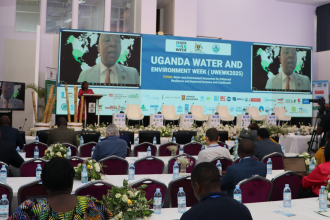
EfD Researchers advocate for efficient use of water and environmental resources
EfD researchers called for more efficient management of water and environmental resources at the 8th Uganda Water and Environment Week (UWEWK 2025). The event, held on March 17-21 and organized by the…
Forest Tenure Reform in Asia and Africa - Local Control for Improved Livelihoods, Forest Management, and Carbon Sequestration
EfD Authors:
Description
Forest tenure reforms are occurring in many developing countries around the world. These reforms typically include devolution of forest lands to local people and communities, which has attracted a great deal of attention and interest. While the nature and level of devolution vary by country, all have potentially important implications for resource allocation, local ecosystem services, livelihoods and climate change.
Biodiversity Conservation in Latin America and the Caribbean - Prioritizing Policies
Description
Latin America and the Caribbean (LAC) region is exceptionally biodiverse. It contains about half of the world’s remaining tropical forests, nearly one-fifth of its coastal habitats, and some of its most productive agricultural and marine areas. But agriculture, fishing and other human activities linked to rapid population and economic growth increasingly threaten that biodiversity. Moreover, poverty, weak regulatory capacity, and limited political will hamper conservation.
Sustained participation in a Payments for Ecosystem Services program reduces deforestation in a Mexican agricultural frontier.
EfD Authors:
AbstractPayments for Ecosystem Services (PES) provide conditional incentives for forest conservation. PES short-term effects on deforestation are well-documented, but we know less about program effectiveness when participation is sustained over time. Here, we assess the impact of consecutive renewals of PES contracts on deforestation and forest degradation in three municipalities of the Selva Lacandona (Chiapas, Mexico).

Makerere honors EfD Uganda leaders and researchers for exceptional achievements
Makerere University celebrated the outstanding contributions of EfD Uganda during a ceremony presided over by the Vice Chancellor, represented by Robert Wamala, Director of Graduate Studies. The event…