
Towards Dynamic Assessment of Determinants of Household Vulnerability to Poverty in Tanzania
EfD Authors:
The paper examines the determinants of vulnerability to expected poverty in Tanzania. Following Landau et al. (2012), Chaudhuri (2000) and Chaudhuri et al. (2003) on estimating Vulnerability to Expected Poverty (VEP), the paper uses a three waves of Tanzania National Panel Survey Data for Tanzania collected between 2008/2009, 2010/2011 and 2012/2013 to find that being employed in agriculture, residing in rural area and household size turns out to be significantly more likely to be poor in the future, at a given consumption level and in all cross-section combination.
Households and tree-planting for wood energy production – Do perceptions matter?
EfD Authors:
While forests are a primary source of energy for the majority of Tanzanian households, the forest cover is rapidly declining. The Tanzanian government has introduced a tree-planting campaign strategy, aimed at reducing pressure on natural forests.
Demographic considerations and food security in Nigeria
EfD Authors:
AbstractClose to 14 million people in Nigeria, including children, are malnourished. I hypothesize that demographic considerations play an important role in food insecurity within Nigerian households. Using data from three waves of the World Bank’s Living Standard Measurement Survey for Nigeria, I illustrate spatial patterns of food security in the country. Using fixed effects regressions, I also show that, at the household level, larger households have worse food security outcomes and are more likely to report being food insecure.
Investigating the long-term effects of child labor on household poverty and food insecurity in Ghana
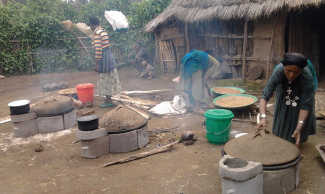
EfD supports the monitoring and evaluation of Ethiopia’s green growth plan
After the Copenhagen Climate Conference in 2009, the Ethiopian government developed a Climate Resilience and Green Economy (CRGE) strategy. It has become a central element of the country’s development

The evolution of the wage gap between rural migrants and the urban labour force in Chinese cities
EfD Authors:
An increasing earning gap between rural migrants and urban residents has recently aroused public concern about rising urban poverty asscociated with migration of rural people into Chinese cities. To address the issue, this paper explores the possibility of wage assimilation for rural migrants towards their urban counterparts and its determinants between 1999 and 2009, by applying an economic assimilation model to analyse a repeated cross‐sectional data for seven Chinese cites at the individual level.
Can climate information salvage livelihoods in arid and semiarid lands? An evaluation of access, use and impact in Namibia
EfD Authors:
Climate forecasting is a crucial tool for managing risks in climate-sensitive economic sectors like agriculture. Although rainfed subsistence farming dominates livelihoods in Africa, information on access, integration in farm decisions and impact of improved seasonal climate forecasting remains scanty. This paper addresses this gap using representative data of 653 households across three regions in North-Central Namibia.