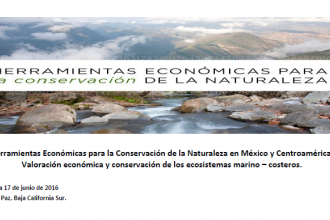
Jorge Dresdner invited to give lectures in Mexico
EfD researcher Jorge Dresdner was invited to give lectures on “Conservation Policies for Marine Resources Based on Rights” During the CSF's course, Herramientas Económicas para la Conservación de la…
EfD researcher Jorge Dresdner was invited to give lectures on “Conservation Policies for Marine Resources Based on Rights” During the CSF's course, Herramientas Económicas para la Conservación de la…
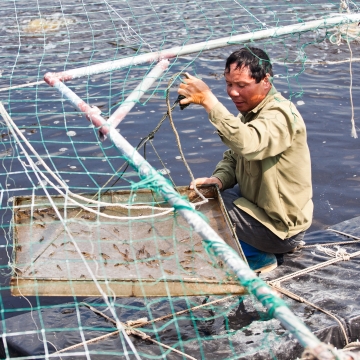
In this study, we measure the value of sanitary restrictions in terms of forgone profits. For this, we model the short-run trade-off between biosecurity and profits in the aquaculture industry.
With considerable focus on ecotourism's potential to contribute to conservation, it is increasingly important to understand the implications of ecological information in triggering sustainability-relevant attitudes and actions. This study assesses whether people who have ecological information regarding the negative impact of their recreational behavior on penguins’ stress will choose to remain farther away from the penguins to avoid that impact although this option will reduce the personal benefits of their tourism experience.
The 22nd Annual Conference of the European Association of Environmental and Resource Economists, is taking place Zurich from June 22-25, 2016. Remember deadline for early registration is April 29…

The EfD annual meeting is a forum to bring together researchers from EfD centers, their collaborators and other key stakeholders for exchange of research ideas, discussion of research proposals and…
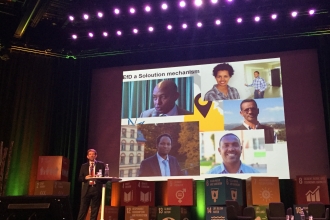
EfD was presented as a solution model for working towards the UN 17 Sustainable Development Goals when the SDSN Northern Europe was launched on February 25-26. Particularly the Ethiopian EfD center…
Representatives from all EfD centers meet to discuss and present their centers Research Policy Review plans
Inshore line fish stocks are severely depleted in South Africa. Although management efforts have addressed pressures from the commercial and subsistence sectors, management of the recreational sector still needs to be addressed. Evidence suggests that spatial management measures would be more successful than traditional size and bag limits. In order to inform a spatial approach, this study investigated the determinants of temporal and spatial variability in angler distribution around the coast.
The amenity value of the Kogelberg Coast of South Africa was estimated on the basis of a survey of users, property data and park visitor statistics, as well as spatial data on coastal features, development and recreational activities. In addition to the permanent population of about 13 000, visitors spend an estimated 4.3 to 5.3 million visitor days per year, of which holiday home owners, other overnight visitors and day visitors account for about 22 percent, 56 percent and 21 percent, respectively. Coastal activities contributed 71 percent to all users’ enjoyment of the area.
Recreational angling in South Africa is not well monitored, even though recreational fishing contributes to over-exploitation of line fish stocks. This is because authorities don’t have the resources or political will to patrol the entire coastline. This study shows that anglers tend to seek out fishing spots where they are likely to catch the most fish. If enforcement officials target these ‘hotspots’, they can monitor whether anglers are adhering to their permit conditions, which limit the number and size of fish that they are allowed to catch.