Markets for Ecosystem Services in China: An Exploration of China's "Eco-Compensation" and Other Market-Based Environmental Policies
This report documents recent policy innovations for the conservation and management of ecosystem services in China.
This report documents recent policy innovations for the conservation and management of ecosystem services in China.
Knowing the local opportunity costs of restricting access to forest land and resources for conservation purposes is an important input to the design of cost-effective conservation schemes that minimize adverse effects on poor forest users.
Deforestation in Ethiopia has resulted in growing fuel scarcity and higher firewood prices in urban centers. Urban centers have long been dependent on the rural hinterlands for their fuel. The use of
In forests managed by participatory management in Tanzania, “volunteer” patrollers often enforce access restrictions, receiving a share of collected fine revenue as incentive. The authors explore how shared revenue and alternative sources of forest products for villagers determine the patrollers’ enforcement effort and decision to take bribes rather than report violators.
Ethiopia’s forest cover is estimated at less than 4% of the total land area of about 1 million km2. The consequences of deforestation and forest degradation include reduced agricultural production and
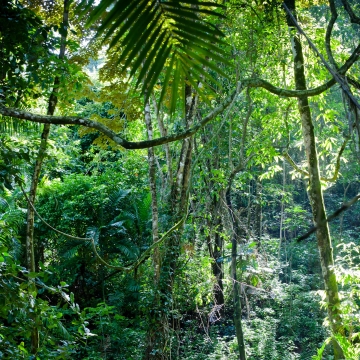
The Kakamega Forest is the only remaining tropical rainforest fragment in Western Kenya and hosts large numbers of endemic animal and plant species. Protected areas were established decades ago in order to preserve the forest's unique biodiversity from being converted into agricultural land by the regions large number of small-scale farmers. Nonetheless, recent research shows that degradation continues at alarming rates.
Tropical deforestation, degradation and forest clearing are important contributors to green house emissions. Some studies approximate that as much as 25% of all carbon dioxide arise from deforestation
In recent times many developing countries have experienced degradation of their natural resource base namely forests, water, fisheries etc. The resource degradation has largely been blamed on the
The broad objective of this project is to examine the role of forests/trees in the livelihoods of households at varying forest management regimes. Ethiopia’s forest cover is estimated at less than 4%
We analyze roles of tenure insecurity and household endowments in explaining tree growing in Ethiopia, where farmers cannot sell or mortgage land and factor markets are imperfect.