EfD-MaK Policy Brief on Changes in Lake Victoria's Hydrology, Water Quality and Livelihoods
KEY MESSAGES
Lake Victoria Basin is facing a number of challenges:
KEY MESSAGES
Lake Victoria Basin is facing a number of challenges:
The collective participation of local communities in the management and utilization of forest resources is now widely accepted as a possible solution to the failure of centralized, top-down approaches to forest conservation.Under such initiatives, communities in Kenya have organized themselves into Community Forest Associations
This paper examines whether offering landless forest-adjacent communities options to grow appropriate food crops inside forest reserves during early stages of reforestation programmes increases incomes of low-income households and conserve forests. We consider the forest cover and household welfare impacts of a unique incentive scheme in Kenya known as the Plantation Establishment and Livelihood Improvement Scheme (PELIS). PELIS seeks to deepen community participation in forestry, and improve the livelihoods of adjacent communities.

ENRRI-EfD Ghana organized training on the environment and natural resource reporting for journalists from key private and public media outlets in Ghana. The two-day training (19 – 20 November) – very…
Abstract
The production of charcoal to meet cooking needs of urban households is one of the main causes of deforestation and degradation of Africa’s tropical forests, which offer significant carbon sequestration capacity to the global economy.
In collaboration with a reputable local micro-finance institution, we designed a randomized controlled trial in urban Tanzania and offered LPG stoves through subsidy and on credit to measure their impact on charcoal consumption and the corresponding reduction in deforestation.
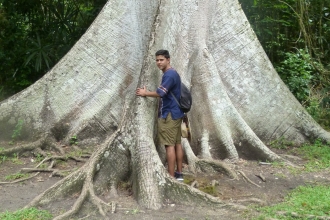
Does the fact that an area is both an indigenous reserve and a national park help saving it from deforestation? That is what Camilo De Los Rios Rueda wanted to find out in his master’s thesis, that…

Dr Zhaoyang Liu, or Leo as he is called by most people, was given the prestigious Peter Berck’s Best Discussion Paper Award at the last day of EfD’s Annual Meeting. The paper focuses on methods of…
It is widely believed that forests help improve water quality by reducing soil erosion (and hence reducing silt) as well as filtering out nutrients and pollutants carried in water, which allows the municipal drinking water supply sector to simplify or expedite many costly water treatment procedures and thereby save on operating costs. This study statistically quantifies such cost savings in the contexts of China’s Sichuan province, by analyzing how drinking water treatment costs change in response to changes in upstream forest cover.