
Does Relative Income Matter for the Very Poor? Evidence from Rural Ethiopia
EfD Authors:
Does relative income have an impact on subjective well-being among extremely poor people? Contrary to the findings in developed countries, where relative income has shown a significant and negative impact on subjective well-being, this study (based on different definitions of reference groups) suggests that relative income does not affect subjective well-being among the very poor people in northern Ethiopia.
Saving lives versus life-years in rural Bangladesh: an ethical preferences approach
EfD Authors:
Using a random sample of individuals in rural Bangladesh, this paper investigates people's ethical preferences regarding relative values of lives when it comes to saving lives of individuals of different ages. By assuming that an individual has preferences concerning different states of the world, and that these preferences can be described by an individual social welfare function, the individuals' preferences for life-saving programs are elicited using a pair-wise choice experiment involving different life-saving programs.
Environmental and development issues in Latin America: moving forward
EfD Authors:
Economists in Latin America are moving beyond the prevailing ‘macro’ orientation of their research focusing more on questions linked to development and the use and management of the environmental resource base in the region.
Environmental and development issues in Latin America: moving forward
Economists in Latin America are moving beyond the prevailing ‘macro’ orientation of their research focusing more on questions linked to development and the use and management of the environmental…
Environmental and Development Issues in Latin America: Moving Forward
EfD Authors:
For the most part, economic research in Latin America has had a ‘macro’ orientation (e.g., economic growth, monetary and fiscal policy, hyperinflation crisis). This is perfectly understandable because of the macro instability that has affected the entire region for decades and that still remains in many places.
Subjective well-being among preadolescents - Evidence from urban China
EfD Authors:
We conducted a survey in the Guangdong province in China to measure happiness among preadolescents and their parents. The objective of this study was to investigate what explains preadolescents’ happiness level and whether their happiness is related to the happiness level of their parents. We do not find any significant relationship with respect to the latter, and the factors that explain the variation in happiness among parents do not explain the variation among children.
Funding a New Bridge in Rural Vietnam: A field experiment on conditional cooperation and default contributions
EfD Authors:
The ability to provide public goods is essential for economic and social development, yet there is very limited empirical evidence regarding contributions to a real local public good in developing countries. This paper analyzes a field experiment where 200 households in rural Vietnam could make real contributions to an archetypical public good, a bridge.
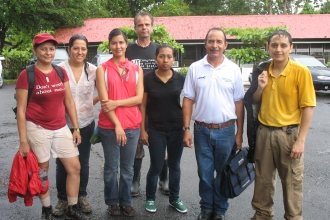
Field Survey Analysis of Conservation Policies and Deforestation Decisions
Through gathering landowners’ experiences and actual practices in situ, researchers at EfD-CA Center work on confirming research findings, contextualize, validate research, and set new hypothesis…