Researchers Trained in Experimental Economics
About 40 researchers on 30th-31st July 2020 converged at Makerere University for a refresher training to sharpen their skills in Experimental Economics. The training held at the College of Business…

About 40 researchers on 30th-31st July 2020 converged at Makerere University for a refresher training to sharpen their skills in Experimental Economics. The training held at the College of Business…
This study revisits the embedding effect, a long-standing problem in the nonmarket valuation literature. The embedding effect was a popular research topic during the 1990s, especially following the Exxon Valdez oil spill in Alaska. It has resurfaced after a special issue of The Journal of Economic Perspectives in 2012 in which Jerry Hausmann asserts that among the three long-standing problems with contingent valuation, the embedding effect is the most challenging.
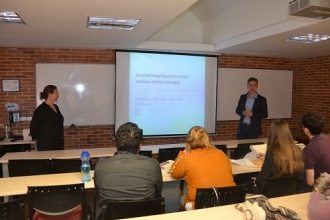
EfD Colombia organized together with CODS (Center for the Sustainable Development Goals) the first environmental economics seminar of the year 2020 at Universidad de los Andes. The seminar was held on…
Abstract It has been demonstrated that most people have a limited understanding of atmospheric CO2 accumulation. Labeled stock-flow (SF) failure, this phenomenon has even been suggested as an explanation for weak climate policy support. Drawing on a typology of knowledge, we set out to nuance previous research by distinguishing between different types of knowledge of CO2 accumulation among the public and by exploring ways of reasoning underlying SF failure. A mixed methods approach was used and participants (N = 214) were enrolled in an open online course.
The relationship between consumer confidence in food safety measures for vegetables sold in open markets and their use of safe food handling practices in the domestic environment was investigated for a set of 332 randomly sampled vegetable consumers within the suburbs of Accra, Ghana.
The objective of this study, which is starting in 2020, is to contribute to the design of policies to reduce marine plastic pollution, by assessing the preferences of households and the welfare
We present the results of a series of economic laboratory experiments designed to study the compliance behavior of polluting firms when penalties are stochastic. The experiments consist of a regulatory environment in which university students faced emission standards and an enforcement mechanism composed of audit probabilities and penalties (conditional on detection of a violation).
Although market-based environmental policy instruments feature prominently in economic theory and are widely employed, they often face public resistance. We argue that such resistance may be driven by moral responsibility, where citizens prefer to tackle the environmental problems that they have caused by themselves, rather than delegating the task to others by means of a market mechanism.