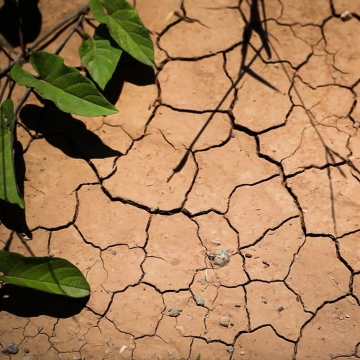
Delayed monsoon, irrigation and crop yields

Submitted by Ishita Datta on
EfD Authors:

Most of the empirical literature assessing the impacts of climate change on agriculture has modeled crop yields as a function of the levels or deviations in the growing-period rainfall. However, an aspect that has received little attention in the empirical literature relates to the relationship between the timing of monsoon rains and crop yields. Using a pan-India district-level panel dataset for 50 years, this article investigates two interrelated issues critical to understanding the impacts of weather-induced agricultural risks and their management.
Agriculture, Climate Change, Land

Assessing the costs of ozone pollution in India for wheat producers, consumers, and government food welfare policies

Submitted by Ishita Datta on
EfD Authors:

We evaluate the impact of ozone pollution on wheat yields in India and its economic consequences for producers, consumers, and the government. Using an ozone flux–based risk assessment, we find that ambient ozone levels led to a 14.18% average reduction in wheat yields from 2008 to 2012. Irrigated wheat was particularly susceptible to ozone-induced losses, highlighting a potential threat to climate-change adaptation through irrigation expansion. Employing an economic model, we analyze the effects of a "pollution-free" scenario on various factors.

Agriculture, Air Quality, Climate Change, Policy Design

EEU Seminar with Moritz Drupp

For this EEU Seminar the presenter will be Moritz Drupp Moritz is a tenure-track Assistant Professor of Economics, esp. Environmental Economics, at the Department of Economics, University of Hamburg…

Date: Monday 26 February 2024 12:10 — 13:15
Location: E44

Blame it on the rain: Rainfall variability, consumption smoothing, and subjective well‐being in rural Ethiopia

Submitted by Mark Senanu Ku… on

AbstractHow does income uncertainty affect individual well‐being? Combining individual‐level panel data from rural Ethiopia with high‐resolution meteorological data, we estimate that mean‐preserving increases in rainfall variability are associated with reductions in objective consumption and subjective well‐being. Mediation analysis suggests that the estimated reduction in consumption does not fully explain the total effect on individual well‐being. Increased rainfall variability also has a large direct effect on individual well‐being.

Climate Change

The gendered effects of climate change: Evidence from droughts in rural India

Submitted by Ishita Datta on

In contrast to previous research, which suggests that women's employment rises during negative household income shocks in low-income economies, the findings in this study, reveal that, despite an increased likelihood of seeking work due to aggregate income shocks, women's employment may not rise if their labor mobility is constrained. Moreover, the impact of climatic shocks may be enduring. The cross-sectional analysis indicates that gender disparities in non-farm employment and migration are more pronounced in villages exposed to higher risks from rainfall variability.

Climate Change, Gender

Tree diversity in a tropical agricultural-forest mosaic landscape in Honduras

Submitted by Marianela Arguello on
EfD Authors:

AbstractBiodiversity decline in the tropics requires the implementation of comprehensive landscape management where agricultural systems are necessarily an integral element of biodiversity conservation. This study evaluates the potential for taxonomic biodiversity conservation within an intensive livestock-agricultural-forest mosaic landscape in Catacamas, Honduras. Tree sampling was performed in 448 plots set up within different forest and agricultural land uses: secondary forests, agroforestry coffee plantations, agriculture, pastures, live fences and riparian forest.

Agriculture, Biodiversity, Climate Change, Conservation, Forestry