Regulation, governance and the role of the informal sector in influencing environmental quality
EfD Authors:
We investigate the effect of the informal sector and a range of governance indicators on both global and local pollutants for a panel of 58 countries during 1996–2011. The analysis employs a fixed effects-instrumental variable generalized method of moments approach. We find that the size of the informal sector has a significant impact on environmental quality, which is conditional on the level of economic development.

EfD helps revolutionize the way governments value nature
In March 2021, the United Nations Statistical Commission took a major step toward moving beyond traditional measures of economic well-being by officially approving a framework for ecosystem accounting

EfD helps chart courses for reducing air pollution in Chile
EfD Chile is working side-by-side with the Ministry of the Environment in the design of a wood stove replacement program and is now participating in developing strategies related to government urban

Electric stoves as a solution for household air pollution: Evidence from rural India.
Who: E. Somanathan Position: Professor, Indian Statistical Institute Info: Electric stoves as a solution for household air pollution: Evidence from rural India. When: Monday, April 12th, 12:05 – 13:00…
Impact of air pollution on short-term movements: evidence from air travels in China
EfD Authors:
While there is abundant evidence demonstrating that residents permanently migrate in search of locations with cleaner air, there are considerably fewer studies that investigate if travellers also take short-term trips to reduce their exposure to air pollution. In this study, we use a complete dataset of flights at Beijing International Airport to investigate if travel patterns are indeed correlated with air quality-differences across cities in China. Our identification strategy is aided by instrumenting air quality using thermal inversions.
WTO accession, trade expansion, and air pollution: Evidence from China’s county‐level panel data
EfD Authors:
This study provides evidence that trade expansion has contributed to the degradation of air pollution in China. On the basis of different responses of counties’ trade to China's World Trade Organization accession at the end of 2001, we exploit air pollution data from NASA to construct a difference‐in‐differences predicted trade as an instrument for our identification. We document statistically significant and robust evidence on trade expansion, which accounts for approximately 60% and 20% for the increase of PM2.5 and SO2, respectively, in China.
Relying on the market to fight air pollution
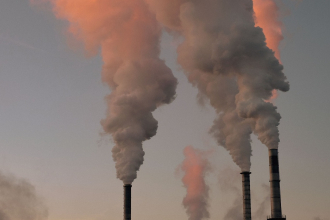
How far should we go to improve air quality? Market instruments inform us about the costs of de-pollution. This information is useful for improving our public policies with regard to health and environmental damage.
The deterrence effect of linear versus convex fines: laboratory evidence
EfD Authors:
Using experiments in which participants play the role of polluting firms, we study compliance behavior with emissions limits under two types of fines and two different regulatory instruments. We find that the market price of pollution permits and the probability of violating permits holdings are higher with a fine that is convex in the level of violation than with one that is linear. This effect operates through an increase in the prices asked by sellers, not in the bids made by the buyers of permits.