


Formal microlending and adverse (or non-existent) selection: A case study of shrimp farmers in Bangladesh
EfD Authors:
Microcredit schemes have become a popular means of improving smallholders’ access to credit and making long term investment possible. However, it remains to be explored whether the current microcredit schemes are more successful than earlier formal small scale lending in identifying successful borrowers. We studied shrimp farming in a rural region in Bangladesh where formal microlending is well established, but where more expensive informal microlending coexists with the formal schemes.
Reference-dependent behaviour of paua (abalone) divers in New Zealand
EfD Authors:
We study dynamic labour supply using data on paua (abalone) divers in New Zealand. The divers face stable, flat prices per kilogram after each catch, but experience transitory wage changes due to varying weather and water conditions, and are free to vary their daily working hours and display an intermittent working pattern. We find nonlinear wage elasticities, rejecting the standard neo-classical prediction that these divers should work long hours during days when wages are high and quit early during days when hourly wages are low.
Distributional effects of taxing transport fuel
EfD Authors:
This paper takes as its starting point the observation that fuel prices – and thus taxes – are important for good management of climate change and other environmental problems. To economists this should be no surprise yet it seems that the role of fuel taxation as an instrument of climate policy has not been fully appreciated. It is however one of the few policy instruments that, since several decades, has actually reduced fuel consumption appreciably.
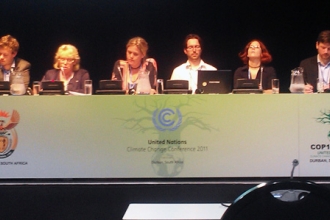
Briefing Report: EfD Side-Event to the UN Climate Change Conference in Durban
This Briefing Report about the EfD Side-Event to the UN Climate Change Conference in Durban 2011 is authored by Mark Purdon, University of Toronto/EfD Research Associate. EfD had a noticeable presence…
PhD programme in Climate Economics at the University of Gothenburg
The Environmental Economics Unit (EEU) at the University of Gothenburg offers five full scholarships in a PhD programme in Climate Economics with admission September 2012. (Assuming the program will…
|
Climate Change |
Sweden

Sterner keynote lecturer at EAAERE 2012 in Indonesia
Thomas Sterner, professor of environmental economics in University of Gothenburg, Sweden, and a fellow at Resource for the Future (RFF), is invited to give a keynote lecture on “The Design of…
Taxes, permits and costly policy response to technological change
EfD Authors:
In this paper, we analyze the effects of the choice of price (taxes) versus quantity (tradable permits) instruments on the policy response to technological change. We show that if policy responses incur transactional and political adjustment costs, environmental targets are less likely to be adjusted under tradable permits than under emission taxes. This implies that the total level of abatement over time might remain unchanged under tradable permits while it will increase under emission taxes.