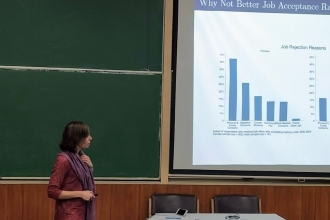
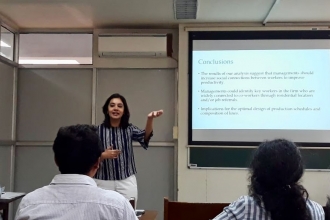
Second Annual Sustainable Energy Transitions Initiative Workshop
The Sustainable Energy Transitions Initiative (SETI) is an interdisciplinary global collaborative that aims to foster research on energy access and energy transitions. Largely comprised of researchers…
First Annual Sustainable Energy Transitions Initiative Workshop
The focus of the 2016 workshop was on the current state of the global energy transition and included topics like; Lack of access to electricity and other modern fuels; Drivers of the energy transition…
Third Annual Sustainable Energy Transitions Initiative Workshop
The third meeting of the Sustainable Energy Transitions Initiative (SETI) took place May 15-17, 2018 at Duke University (Durham, NC). As with prior meetings, we brought together leading experts…
Fourth Annual Sustainable Energy Transitions Initiative Workshop
The fourth meeting of the Sustainable Energy Transitions Initiative (SETI) took place May 15-17, 2019 at University of Talca in Santiago, Chile. The workshop was co-hosted by the University of Talca…
Virtual Workshop: Energy Access Through a Gender Lens
Energy Access Through a Gender Lens: A Workshop to Chart a Research Agenda The Sustainable Energy Transitions Initiative (SETI), Women in Environmental Economics for Development (WinEED) Initiative…
Fertilizer Policy of 2010-2015 and Changes in Farmers Fertilizer Use and Revenue in Taraba State, Nigeria
This study ascertained if the fertilizer policy of the Transformation Agenda; 2010-2015 made any difference in Nigerian farmers’ fertilizer use rate and their revenue. It examined the fertilizer use rate by farmers before and during the policy period and, analyses the effect of the policy on the revenue of farmers before and during the policy period. A paired t-test was employed to examine the fertilizer use rate and revenue of farmers before and during the policy period.
Challenges of Youths Involved in Fish Farming in the Federal Capital Territory, Abuja, Nigeria
This study determined the challenges of youths involved in fish farming in the Federal Capital Territory, Abuja, Nigeria. Multi-stage sampling procedure was used to select and interview a total of 54 youth fish farmers’from18 villages in three area councils of the FCT, Abuja. Results of the analysis were presented using percentage, frequency counts, and mean scores. Results reveal that majority (57.4%) of the respondents had fish farming as their major occupation. The majority (87%) of respondents adopted the monoculture system of fish production.
Value reclamation from informal municipal solid waste Management: Green neoliberalism and inclusive development in Lagos, Nigeria
Lagos is undoubtedly the cultural capital and economic hub of the West African sub-region. The challenge of municipal solid waste management (MSWM) in the megacity has remained intractable due partly to the increasing rate of population growth. While solid waste policy reforms, investments, and management practices in Lagos are in the upswing in the formal economy, the role of the informal economy in engendering sub-regional material linkages and livelihoods remain unexplored.
Assessment of the groundwater quality of a highly populated district in Enugu State of Nigeria
This study assessed the water quality of the hand-dug well groundwater of Independence Layout, a highly populated district of Enugu Metropolis in Enugu State of Nigeria by sampling 14 hand-dug wells during the rainy and dry seasons. Samples were collected in such a manner as to ensure that each of the seven zones that make up the district had two wells sampled. The water quality was assessed based on the biological and physico-chemical properties of the groundwater. Atomic absorption spectrometry was employed in the laboratory analysis of the heavy metals.