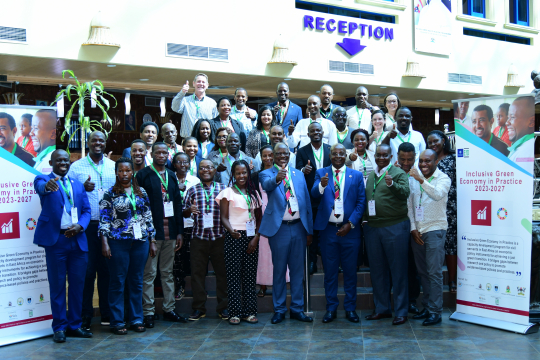
The Vice Chancellor of Makerere University, Barnabas Nawangwe, appealed to fellows and alumni under the Inclusive Green Economy (IGE) program in East Africa to prioritize practical solutions for feeding the region’s rapidly growing population, considering that climate change and declining agricultural productivity pose a serious threat to livelihoods.
Prof. Barnabas Nawangwe was opening a five-day cross-country peer learning workshop in Entebbe, which convened IGE fellows from Uganda, Kenya, Tanzania, Rwanda, and Ethiopia
The Vice Chancellor described East Africa as the “cradle of mankind,” referencing historical and scientific claims linked to sites such as Oldvai Gorge in Tanzania, Ethiopia, and Kenya. However, he noted that despite this rich history, the region now faces severe environmental and economic challenges.
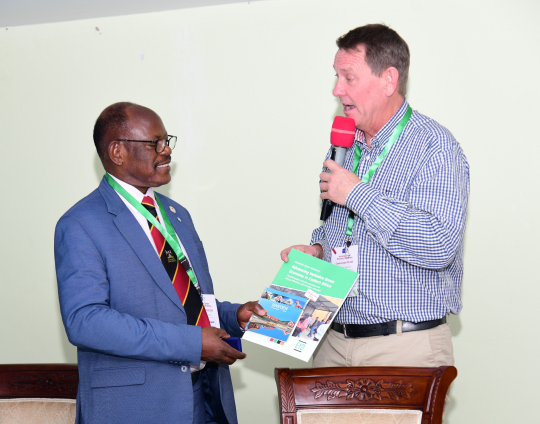
Drawing from personal experience, Barnabas Nawangwe contrasted the lush, forested landscapes of his childhood in Busia with the current reality of dense human settlements and over-cultivated, less productive farmland.
“Now if I go from Busia to Kampala, I practically go through a long street of buildings… and very shabby-looking gardens,” he said. “The yields are going down.”
He warned that population growth in East Africa has far outpaced food production, citing research indicating that cereal production in the 1960s was double current levels, even as the population has increased sixfold.
“We are the fastest-growing region of the world, but we must ask: who is developing and how are we developing?” he posed. “Is it sustainable?”
Nawangwe stressed that an inclusive green economy must begin with food security. “For any government, the first responsibility is to make sure that people are well fed, even if they don’t have anything else,” he said.
He highlighted the barriers farmers face in adopting modern agricultural practices, particularly the high cost of irrigation systems. “Even with government subsidy, I was told I need 20 million shillings to invest in irrigation. If a vice chancellor cannot afford that, what about the farmer in the village?” he asked.
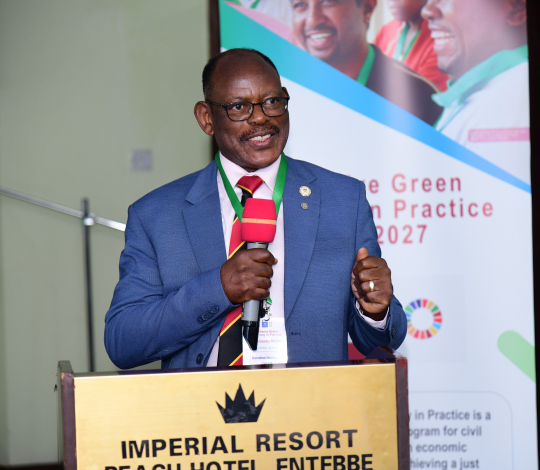
The Vice Chancellor called for affordable, scalable innovations in agriculture, including low-cost irrigation systems, improved seed varieties, and climate-resilient crops. He noted that Makerere University is already undertaking interdisciplinary research involving agriculture, veterinary science, law, and social sciences to address these challenges.
“We must double or even multiply by five times the yield per acre if we are going to feed this population,” he said.
Nawangwe also underscored the disproportionate impact of climate change on East Africa, citing erratic rainfall patterns, droughts, and floods that continue to undermine agricultural productivity. He commended the EfD program for bridging research and policy, particularly through engagement with government officials attending the workshop. “Our responsibility as the few privileged, educated people is to get solutions for the survival and inclusive green economy for our people,” he said.
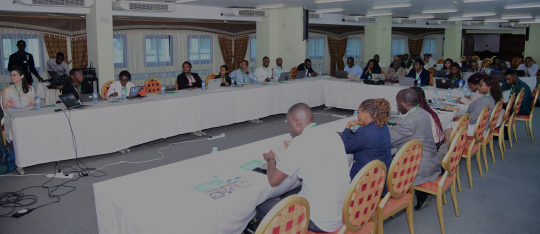
In his remarks, Prof. Nawangwe also acknowledged longstanding support from Sweden, which he said played a critical role in rebuilding Makerere University’s research capacity after years of civil strife.
“With their help, we trained 500 PhDs in 20 years, the largest staff development program I have known anywhere in the world,” he noted.
He officially declared the workshop open, expressing optimism that it would generate actionable insights to address one of the region’s most pressing challenges: feeding its people sustainably.