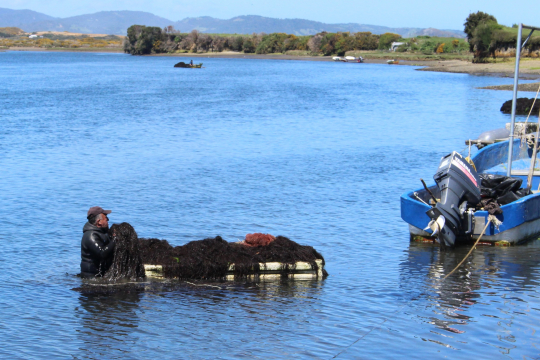
A recent study by EfD-Chile researchers reveals that increases in black kelp export prices do not translate into higher incomes for the harvesters. The paper Who captures the value? How intermediaries and exporters shape Chilean kelp prices in a small-scale fishery based on extraction was published by Leonardo Salazar, Jorge Dresdner, and Manuel Estay.
Black kelp (Lessonia berteroana) is one of the primary seaweed species commercialized by small-scale fishers and coastal gatherers in Chile. Using price data observed at different stages of the chain, the study evaluated whether price signals are transmitted efficiently among market actors.
The results show that the export price of black kelp is not connected to the price that harvesters receive at the beach. This means that when the value of the resource rises in international markets—particularly in China—that increase does not necessarily reach those doing the extraction.
If the value chain were integrated, increases in the seaweed's overseas value should translate into better incomes for fishers and gatherers in Chile. However, the results show this is not happening.
This study grew out of an interest in analyzing efficiency within the black kelp value chain, following previous ethnographic research that documented significant power asymmetries among chain participants.
Specifically, intermediaries, processors, and exporters appeared to hold greater bargaining power than the gatherers, influencing how prices are set.
Public policy implications
This lack of integration could be linked to a concentration of purchasing power in the export sector, or a reliance on intermediaries to connect extraction activities with international markets, among other factors.
Therefore, the study proposes three recommendations for policymakers to achieve a more equitable distribution of the economic benefits generated by the activity and to improve value chain efficiency. Improving the price information system for seaweed gatherers to increase their bargaining power, reforming the traceability system to prevent illegally harvested seaweed from entering the chain, and reducing gatherers' dependence on intermediaries.
The authors noted that there are plans to continue this line of research by further analyzing the chain through other means.
By Belén Pulgar.