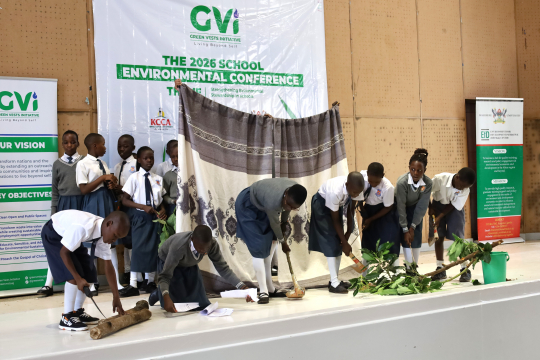
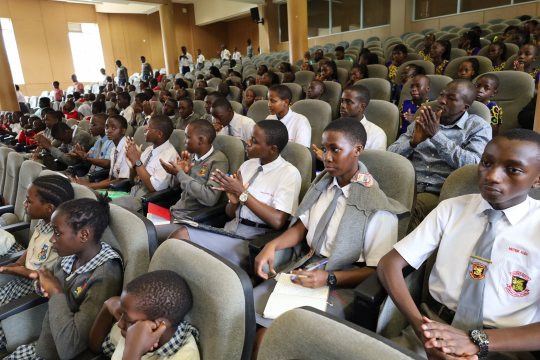
More than 250 primary school students participated in the Inaugural Schools Environmental Conference at Makerere University, aimed at promoting environmental awareness and responsibility among young learners. The event was organized by EfD Uganda in partnership with the Green Vest Initiative, the National Environment Management Authority (NEMA), and the Kampala Capital City Authority (KCCA).
The half-day conference, held under the theme Strengthening Environmental Stewardship in Schools, brought together primary five to primary seven students, teachers, and environmental stakeholders for interactive sessions designed to inspire practical action in schools and communities.

Schools key to save the environment
Peter Babyenda, representing the College Principal and Director of the EfD Uganda, emphasized the pivotal role schools play in shaping environmentally responsible citizens. “Schools provide a platform for teaching young people skills and values that influence behaviour not just now, but for life,” he said. He encouraged students to adopt positive practices such as participating in clean-up campaigns, planting trees, and maintaining school gardens.

Peter Babyenda also highlighted the harmful practices that contribute to environmental degradation.
“Most of the floods you see are likely caused by us. Littering, dumping waste into drainage systems, and cutting down trees irresponsibly are damaging our communities,” he said. He stressed that habits formed in schools, whether good or bad, have a direct impact on the broader environment.
He urged teachers to guide pupils toward sustainable habits early. “You can play a great role in safeguarding the environment if you teach these young ones from the start. It is very easy to change behavior from the beginning,” Babyenda said, calling for school clubs, peer learning, and greening initiatives like school woodlots under the Green School Programme.
He also encouraged students to take personal responsibility and adopt simple, symbolic actions to protect the environment.
“Even small actions matter—plant a tree on your birthday or remind family members not to throw rubbish out of car windows. These simple steps celebrate life while protecting our future,” he said, highlighting that everyday practices can create lasting environmental impact.
Green Vest Initiative champions student-led environmental action
John Robert Tenywa, Team Lead of the Green Vest Initiative, called on students to live beyond personal needs and protect shared resources.
“We are focusing on raising a generation that lives beyond itself, one that is mindful of the environment and committed to making a difference,” he said.

John Robert Tenywa outlined the initiative’s activities, including cleaning public spaces, educating communities, and promoting waste management practices that turn waste into value. He added that monthly outreach combines clean-up campaigns with sensitisation, tackling the root causes of environmental degradation.
He also highlighted the faith-based foundation of the initiative, which integrates moral and spiritual values into community engagement.
“By combining values with action, we hope to inspire pupils to adopt sustainable practices both in school and at home,” he said.

”Everyone has a legal duty to safeguard the environment”
Wilber Ikalai, NEMA Manager of Environment Education and Advocacy, reminded students that they have a legal duty under the National Environment Act to maintain a clean and healthy environment.
“The greatest threat to our planet is the belief that someone else will save it,” he said, quoting environmentalist Robert Swan. “Each of us must act responsibly – do not wait for others to do it for you.”

Wilber Ikalai emphasized that environmental stewardship extends beyond forests and rivers to daily human behaviors. He cited overprinting, unsafe food packaging, overuse of water, and improper waste disposal in schools as detrimental practices.
“If you don’t take care of yourself, you are part of the pollutants affecting your environment,” he said, urging students to adopt green habits.

He called on learners to actively report harmful practices, influence their peers, and participate in sustainable initiatives.
“Students are the stewards of the environment for the coming generations,” he said.
“Your choices today will shape the environment of tomorrow.”

By Jane Anyango