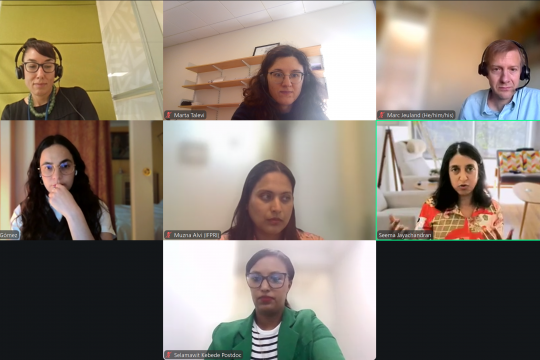
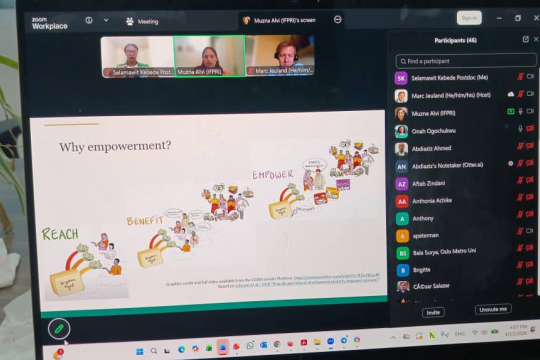
In a recent webinar hosted by the Sustainable Energy Transitions Initiative (SETI), an international panel of researchers shared experiences and challenges in designing indicators to measure women's empowerment within energy contexts.
The event Designing gendered empowerment indicators: sharing technical guidelines, experiences, and challenges across countries and domains, moderated by EfD and SETI fellows, Selamawit Kebede, Marc Jeuland and Marta Talevi, focused on the urgent need for a tool that captures the many sides of empowerment—moving beyond simply having electricity to also measuring who has control over energy decisions and how energy access impacts a woman's time and labor.
Challenges and advice for measuring women’s empowerment
EfD fellow Chizoba Oranu (University of Nigeria), presented on behalf of the research team, how a new SETI collaborative project aims to respond to this need by designing and piloting a Gender Empowerment in Energy Index (GEEI) which aims to enhance our understanding of the multidimensional and gendered aspects of energy use, directly supporting SDG 5 (Gender Equality) and 7 (Affordable and Clean Energy).
Muzna Alvi, a researcher at the International Food Policy Research Institute (IFPRI), detailed how the Women's Empowerment in Agriculture Index (WEAI) framework has evolved since 2012, and explained that by creating specific, actionable metrics, policymakers can pinpoint exactly where and why disempowerment occurs.
A flexible adaptable design
Professor Seema Jayachandran (Princeton University) suggested that researchers should distinguish between energy-specific measures of agency and general measures used in fields like agriculture and recommended developing flexible tools. Seema also emphasized the importance of distinguishing when decision-making and task management represent genuine sources of power or an added chore.
Adding to this, Amber Peterman (UNICEF), empasized that for this index to work, it must be theoretically grounded, interpretable, and useful. Amber also stressed the need for a certain balance to ensure the index is useful across different settings and encouraged continued learning and adaptation in the development process.
The urgency of this work is highlighted in the webinar when also addressing the growing threat of “time poverty” women face. As climate change makes natural resources more difficult to collect, women are spending more hours on these tasks. The research team aims to move these new indicators from pilot projects into national statistics, to ensure that future energy policies do not just light up homes but truly power up women’s lives.
For more related information, access here:
-
Alvi, M., Ferguson, N., Heckert, J., & Kundu, T. (2025). Measuring collective agency in women's self-help groups: Comparing measurement approaches and practical guidance for scaling.
-
Delea, M. G., Sinharoy, S. S., Cheong, Y. F., Heckert, J., Seymour, G., Meinzen‐Dick, R., & Yount, K. M. (2025). The Group‐Related Collective Agency Scales (GCAS‐23 and GCAS‐12)—Full and Short Form Scales for Construct Measurement. Journal of Community & Applied Social Psychology, 35(6), e70195.
-
Policy note summarizing insights from India, Nepal and Pakistan: Alvi, M., Sufian, F., Ringler, C., Singh, T., Beniwal, E., & Raja, S. (2023). Women’s empowerment and energy access: Insights from India, Nepal, and Pakistan.
By Belén Pulgar, Chizoba Oranu and Marta Talevi.