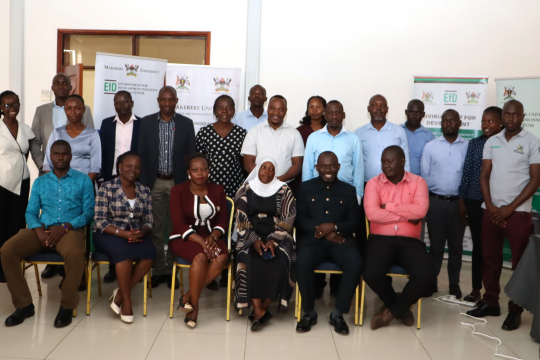
Knowledge on how to value natural resources is essential to guide policy decisions and prevent environmental degradation. Environmental and natural resource officers from Eastern Uganda have undergone intensive training on the valuation, evaluation, and accounting of natural resources to strengthen evidence-based environmental management at the district level.
The training brought together district environmental officers, forestry officers, agricultural officers, planners, and natural resource managers from Palisa, Butebo, Busia, Bukedea, Jinja, Mbale, Kapchorwa, Iganga, and Soroti. Organized by EfD Uganda and funded by the Government of Uganda through the Makerere University Research and Innovation Fund (Mak-RIF), the program equipped participants with practical tools for sustainable resource management and climate resilience.
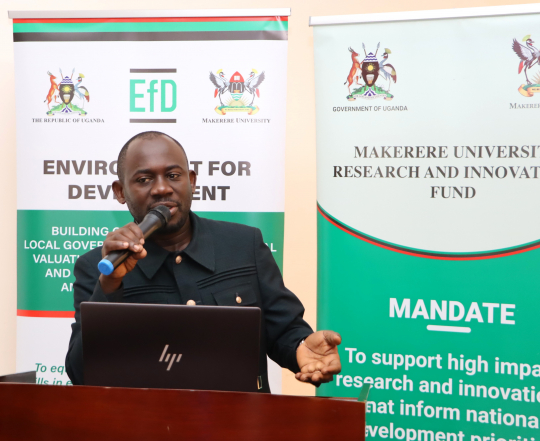
EfD researcher Peter Babyenda emphasized the need for continuous skills development. “Capacity building is critical. We must keep reminding ourselves and sharing experiences so that we remain relevant and effective in our roles,” he said. Babyenda outlined the program’s focus areas, including environmental valuation and evaluation, environmental accounting and climate change mitigation, and adaptation.
He stressed the importance of quantifying the economic value of natural resources to guide policy and prevent degradation.
“If districts can assess and assign value to resources like swamps and forests, it strengthens national planning and ensures these resources are not undervalued or degraded,” he added.
Facilitators included Peter Babyenda, who presented on environmental valuation and evaluation, Nick Kilimani, who led sessions on environmental accounting, and Alice Nalweera, who covered climate change mitigation and adaptation strategies.
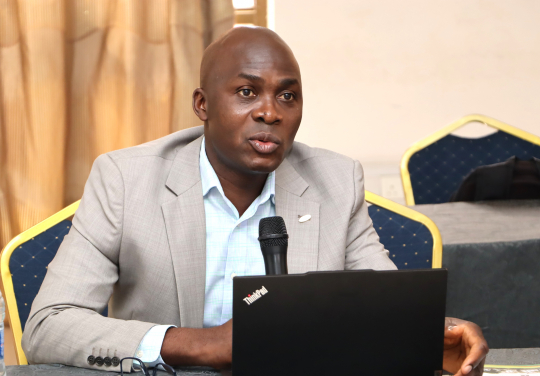
Nick Kilimani explained that proper accounting integrates environmental and economic data, ensuring resources are sustainably used.
“You are the gatekeepers of Uganda’s natural wealth. Proper environmental accounting ensures that resources are used sustainably, benefiting both the economy and the people,” he said.
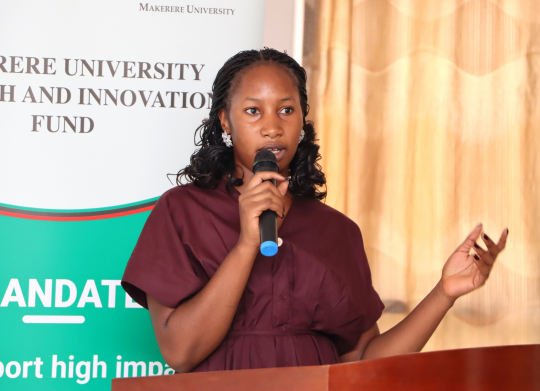
Alice Nalweera urged practical action on climate change, emphasizing the distinction between short-term weather and long-term climate patterns.
“Adaptation and mitigation must go hand in hand. Practical solutions, community engagement, and informed policy decisions are key to safeguarding livelihoods, enhancing resilience, and promoting sustainable development,” she said.
District officers highlighted the relevance of the training to their daily responsibilities. Nakayenze Anna, Head of Natural Resources, Mbale district, said, “This training has been very beneficial. It has highlighted the government’s commitment to integrating environmental reporting into our frameworks. The challenge remains building capacity to collect and manage data across sectors.”
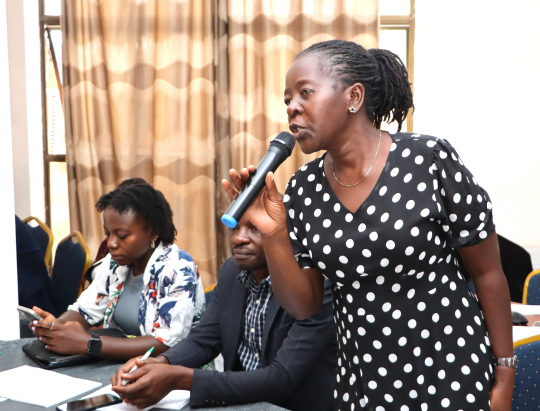
Maganda Moses, Principal Environment Officer, Jinja district, emphasized valuing natural resources economically. “We have forests, wetlands, and Lake Victoria, but for a long time, we haven’t attached economic value to these resources. Local governments must step forward to mobilize resources to safeguard these critical assets,” he said.
Chelimo Salim, environmental officer, Kapchorwa district, reflected on practical application. “We have learned about environmental evaluation, valuation, and climate change mitigation and adaptation. I will take this knowledge back to Kapchorwa to encourage communities to conserve the environment, plant trees, and protect wetlands,” he said.
Florence, district environmental officer, Iganga, added, “I have learned more about adaptation responses to climate change. The training was very appropriate, though I wish it could have been a little longer to allow more in-depth learning.”
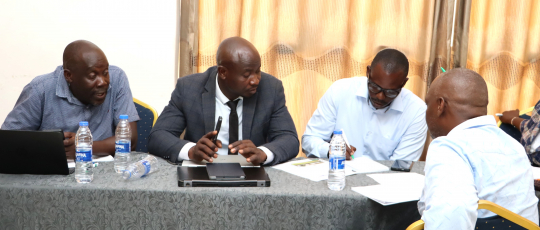
Edwin Masheta, planner, Iganga district, noted, “communities often confuse weather with climate change. This training has given me a long-term perspective, particularly on mitigation and adaptation measures. I believe initiatives like this will drive meaningful change at the local level.”
Participants agreed that the skills acquired will inform future planning and implementation of environmental policies, strengthening the role of local governments in sustainable natural resource management.
By: Jane Anyango