A new study presented experimental evidence on managing common pool resources, revealing that expelling uncooperative members from environmental groups only protects natural resources if borders are strictly monitored.
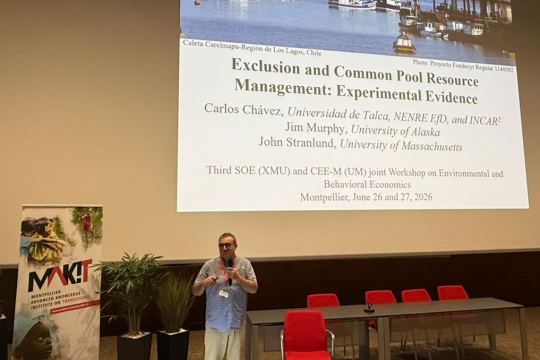
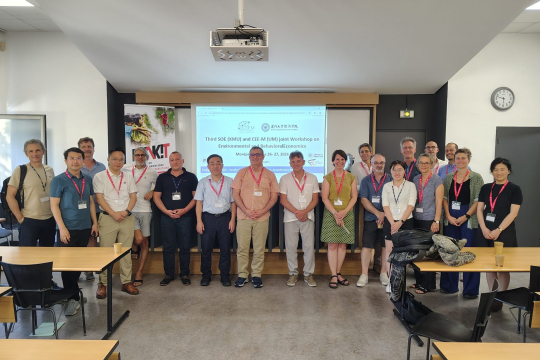
NENRE EfD-Chile fellow and lead researcher Carlos Chávez, presented the paper Exclusion and Common Pool Resource Management: Experimental Evidence, co-authored with James Murphy (University of Alaska) and John Stranlund (University of Massachusetts); in the Third SOE (XMU-Xiamen University) and CEE-M (Universidad de Montpellier) joint Workshop on Environmental and Behavioral Economics, held on June 26-27 at the University of Montpellier, France.
The dangers of “poaching”
Authors examined how excluding individuals from groups that manage common pool resources affects both resource use and social welfare. Using laboratory experiments, the researchersexplored what happens when excluding individuals can continue accessing the resource through illegal extraction or “poaching”, and whether enforcement changes those outcomes.
The results show that while the threat of expulsion encourages better behavior among those who stay, it creates a new problem: excluded members often keep extracting resources illegally. The study concludes that ostracism only works as a governance tool when resource boundaries are heavily enforced. Otherwise, it reduces overall social welfare by driving people to operate in the shadows.
The research highlights that exclusion can be an effective governance tool only when resources boundaries are well enforced.
Also, this paper is the first scientific output from the Chilean Fondecyt Regular Project 1230266 The Endogenous Formation of Common Pool Resource Coalitions under Uncertainty and Exclusion, led by Carlos Chávez. The project studied how groups form and govern shared natural resources under conditions of uncertainty and exclusion.
Therefore, there are more research papers to come while the presented study is currently being prepared for submission to a peer-reviewed scientific journal.
Building international research collaboration
Carlos Chávez commented that participating in this workshop provided an important opportunity to exchange ideas with leading scholars working on similar questions, and pointed out that the Environmental Economics group at the University of Montpellier is internationally recognized for its work in experimental and behavioral economics, making the event an important venue for discussing frontier research in the field.
The workshop brought together researchers from around the world to discuss cutting-edge research in environmental and behavioral economics. The program featured empirical and theoretical studies, with a strong emphasis on laboratory and field experiments that explore how people make decisions related to environmental management.
By Belén Pulgar.