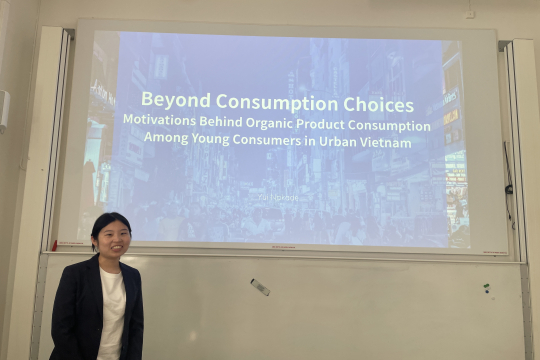
When Yui Nakade, a master's student at Lund University in Sweden, arrived at Ho Chi Minh City by video call in early 2026, she was trying to answer a simple question: why are young Vietnamese consumers becoming interested in organic products? Her working theory was that traditional values, passed down through generations, would explain it. Her fieldwork, carried out with the support of EfD Vietnam's student network, told a different story: health and family trust matter far more than tradition, and many young people know less about organic products than she expected.
Yui reached out to EfD Vietnam in February 2026 looking for young residents of Ho Chi Minh City willing to sit for a 30 to 40 minute interview about their values and consumption habits. Her first round of outreach found two participants. She needed at least ten.
EfD Vietnam re-shared her call for participants through its network at the University of Economics Ho Chi Minh City after the Tet holidays. Within days, close to twenty candidates had signed up, more than Yui had expected. From that pool, she interviewed twelve young consumers, together with five people working in Vietnam's organic food and cosmetics industry.
What she found
The people her interviewees trusted most were their own families. Parents who insisted on visiting the same local market, or who linked a higher price to a safer product, shaped how their children shopped years later. One participant recalled his family's reasoning simply: "Cheap means maybe there is a problem in it." Health, not environmental concern, was the strongest personal motivation across nearly every interview, a pattern experts in the organic industry echoed as well.
What surprised Yui most was what did not explain the interest. Childhood experiences with environmental concern, and broader traditional beliefs about harmony between people and the environment, showed only a limited connection to buying organic products today. Meanwhile, confusion about certification, limited access outside of a few trusted shops, and a sense that organic products are meant for older or wealthier consumers all stood in the way of turning interest into a habit.
Why it matters beyond one thesis
Vietnam's organic market is still small by global standards, but it is growing quickly, and Gen Z will make up a large share of its future customers. Yui's findings point to a fairly direct opportunity for the organic industry: talk about health first, be transparent about where a product actually comes from, and consider that many young consumers have simply never encountered clear information about organic products, rather than assuming they have already dismissed them.
Yui's thesis was published through Lund University in June 2026, and EfD Vietnam is credited in its acknowledgements for its role in participant recruitment.
“Without the support of EfD Vietnam, my data collection would not have been nearly as successful. Their support bridged the distance between Sweden and Vietnam, which I found extremely challenging at the beginning” said Yui Nakade.
A pattern, not a one-off
Yui's experience is part of a longer list of international students who have come to Vietnam for fieldwork with support from EfD Vietnam and EEPSEA, from master's students conducting interviews to PhD researchers running economic experiments and field surveys. Each project is different, but the underlying offer is the same: a local network that can help a visiting researcher turn a research question into real data, in a country where that groundwork is often the hardest part.
If you are a student or researcher planning fieldwork in Vietnam, EfD Vietnam would like to hear from you.
Contact: efd@eepsea.org