
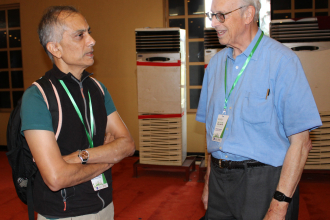
“Economists need to be empirical in teaching and researching the economics of water”
Professor Michael Hanemann urged economists to be empirical rather than theoretical when teaching and researching the economics of water when he made his keynote presentation at EfD’s Annual Meeting…

Uganda’s policymakers implored to address forest loss, plastic and water pollution
Policymakers in Uganda were urged to take measures to mitigate environmental degradation or else, risk facing serious consequences. The appeal was made during the opening of the 16th EfD Annual…
Time for Clean Energy? Cleaner Fuels and Women's Time in Home Production
EfD Authors:
In much of the developing world, cooking accounts for most of women's time in home production. Does reliance on biomass for cooking drive this time burden? To assess time-savings from shifting towards cleaner fuels, we revisit a clean energy information experiment in rural India. Treatment villages were randomly assigned to receive information about negative health effects of cooking with solid fuels and about public subsidies for cleaner Liquid Petroleum Gas (LPG).
Can transitioning to non-renewable modern energy decrease carbon dioxide emissions in India?
EfD Authors:
Traditional discussions of the relationships between energy, carbon dioxide (CO2) emissions and human development fail to expose within country energy and CO2 emissions inequality. This work seeks to elucidate these inequalities in India and then investigate the consequential impacts on welfare and CO2 emissions of India's transition away from energy poverty. The study uses the India Human Development Survey and the EORA database to generate household Human Development Index scores, consumption and CO2 emissions distributions for India in both 2005 and 2012.
Is biofuel expansion in developing countries reasonable? A review of empirical evidence of food and land use impacts
EfD Authors:
Policy expectations from biofuels have been a widely contested issue. Lately, the risks and uncertainties associated with the unintended consequences of biofuels in terms of food and land-use changes have issued serious concerns for scaling biofuels in developing countries. The current policy question revolves around whether the trade-offs between food and fuel are less harmful or unwarranted for developing countries and which aspects are likely to be critical in determining future biofuel endorsements in developing countries.
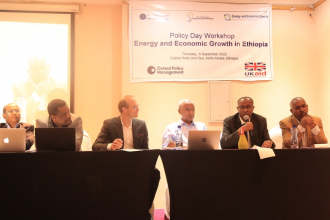
EfD Ethiopia held policy day workshop on Energy and Economic Growth in Ethiopia
The Environment and Climate Research Center (ECRC) at the Policy Studies Institute (PSI) held a workshop to present the policy-relevant insights in collaboration with Oxford Policy Management in…
Uncertainty-dependent and sign-dependent effects of oil market shocks
EfD Authors:
This paper investigates the uncertainty-dependent and sign-dependent effects of the oil market fundamental shocks, namely supply, aggregate demand and oil-specific demand shocks. We do so by first proposing a novel oil uncertainty index that is measured by the stochastic volatility of the unpredictable component of oil prices. We then employ a nonlinear model and find that the all reactions of oil production, real price of oil, and global economic activity to the structural shocks are regime-dependent.
Policy options for offshore wind power in Vietnam
EfD Authors:
This study assesses key barriers to offshore wind power (OWP) development in Vietnam and policy options for the development of the sector. A survey of 39 experts from government agencies, research institutions, industry, and civil society plus 22 follow-up interviews were conducted over January–September 2021, coupled with a broader analysis of key barriers and policy options.
Is ASEAN ready to move to multilateral cross‐border electricity trade?
EfD Authors:
This paper reviews progress towards the establishment of an Association of Southeast Asian Nations (ASEAN) Power Grid (APG) and the key barriers to multilateral cross-border electricity trade in ASEAN. An analysis across political, technical, institutional, economic, environmental, social and time dimensions is employed. Using a policy sequencing framework, the paper concludes it remains premature for ASEAN to pursue a strong form of power sector market integration on account of the sizeable barriers that currently remain, especially economic and institutional barriers.