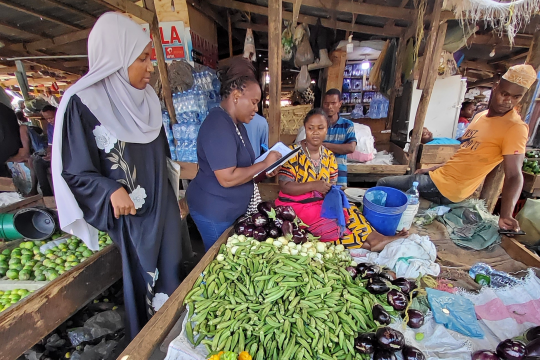
EfD Tanzania researcher Dr. Innocensia John has dedicated her work to indigenous crops for years, emphasizing their role in nutrition, climate adaptation, and economic empowerment for smallholder farmers in Tanzania. She has worked extensively with policymakers, farmer groups, and other stakeholders and has received international recognition for her work. Still, there are obstacles to overcome before indigenous crops are on everybody’s table.
Indigenous crops, also referred to as orphan or neglected crops, are plants that are traditional to a region and consumed as part of a traditional diet. Since the Tanzanian government (and many others), as well as the farmers, have focused largely on conventional crops, such as coffee, cashew nuts, and maize, since the 1960s, the indigenous crops have, to some extent, fallen into oblivion.
Provides many benefits
However, they provide an important opportunity for crop diversification, which is not only beneficial for the soil but also for the food security of the individual farmer. Indigenous crops such as cowpea, pigeon pea, sorghum, baobab, and cassava are also resilient to the effects of climate change since they can adapt to wide variations in temperature and rainfall. In addition, these crops are often packed with essential nutrients that offer great health benefits.
“One problem is that there is currently very little demand for these crops. Many people are not familiar with them, and you don’t find them in the big supermarkets,” explains Innocensia John.
“There is a need for awareness campaigns to inform both producers and consumers about the many advantages of the indigenous crops,” she says.
Engaging with policymakers and stakeholders
Innocensia Johns’ tireless work for many years to do just that – conduct research and meet with policymakers, farmers, and other stakeholders to disseminate information on indigenous crops, has, among many other things, led to a prestigious, international award: Top Agri-Food Pioneers (TAP) for her "significant impact on agriculture and food systems".
Her work shows that indigenous crops are important for food and nutrition security, climate adaptation, and agricultural diversification, and offers concrete advice on agricultural extension services, seed policies, and school feeding programs.
Raising awareness
She has contributed broadly to raising awareness in her country. For instance, she was invited as a speaker to the Annual Agricultural Policy Conference in 2023, where she talked about her research on indigenous crops. This conference usually attracts 300-400 local participants and over 200 international. It’s a high-level meeting where researchers present their work, NGOs talk about their experiences, and policymakers from the ministries of agriculture, livestock and fisheries, finance, local governments and parliamentary committees join in discussions.
“ I felt that there was a lot of interest in what I said,” she says.
Became focus theme
“And the next year, when I was invited as a speaker again, I got more opportunities to talk to high-level decision-makers, such as the ministers of agriculture and investment, and even had a side-event on indigenous crops. And in 2025, the main theme of the conference was indigenous fish, insects, and crops.”

Professor David Nyange is an agricultural economist and the Executive Director of ASPIRES Tanzania (advising the government on agricultural matters). He is involved in organizing the Annual Agricultural Policy Conference.
“It’s very valuable to have Innocencia John join our team, and she has really helped bring the issue of indigenous crops to the attention of policymakers and shown how they can have an important role in modern food systems,” says David Nyange.
“For instance, after the conference in 2025, we were approached by the Presidential Agricultural Delivery Council, which is part of the African Union, where the Presidents of Africa strive to promote food security. They specifically asked for policy briefs on indigenous crops,” he said.
Engaging with farmers
She has also met with COPRA, the (Cereals and Other Produce Regulatory Authority), and convinced them to include indigenous crops in their systems for seed banks, etc.
But she isn’t just meeting with high-level government officials, but also with farmer groups, both as part of the research and to inform them about the benefits of indigenous crops.
“Crops with enormous potential for soil fertility – such as sorghum, cowpea, and pigeon pea – should be promoted by extension services personnel. With diversification, they can also improve household dietary diversity and food and nutrition security.”
Obstacles and opportunities
So, why aren’t the indigenous crops grown and produced more widely? For one thing, there is not really any market infrastructure. Also, there is the demand issue: Some of the indigenous crops are not very tasty by themselves. And the knowledge about them and their benefits is low.
But there is, according to Innocensia John, great market opportunities for value addition. For example, cowpeas can be consumed as a vegetable, the flour can be used to prepare snacks, and the dried beans can be used as a key ingredient in stews.
She is now leading a project where they combine moringa leaves, soya, and maize into a porridge and target school children in Tanzania, teaching the schools and families how to make the porridge.
Read her policy brief on indigenous crops
By: Petra Hansson