In northern India, where air pollution is a growing health crisis, researchers, in collaboration with journalists, have investigated ways to raise awareness by putting science in the public's hands through the media.
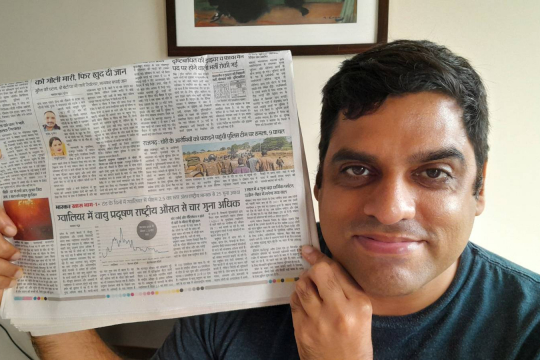
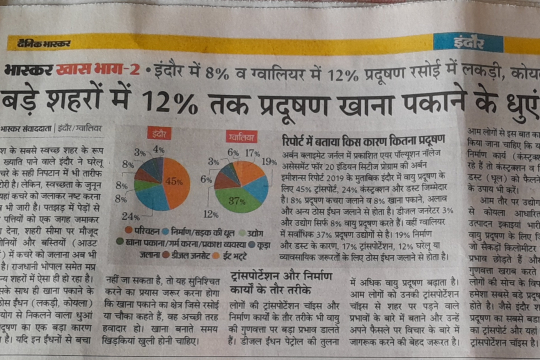
The project, Clearing the Air: The Impact of Local Media on Public Understanding of Air Quality, was led by EfD India researcher Kanishka Kacker and Martin Mattsson of the National University of Singapore. They partnered with Dainik Bhaskar, one of India’s largest regional-language newspaper networks, to publish a series of editorials in Hindi across two cities: Gwalior and Indore. Dainik Bhaskar has an average issue readership of 15 million, according to the Top 10 Hindi Newspapers in India 2025 – Most Popular List.
“Outside of Delhi, many people don’t even realize how bad the air is,” said Kanishka Kacker. “The entire northern plains are equally polluted, but the awareness isn’t there. There are signs in Delhi informing about the levels of air pollution, but most other cities don’t have that, and you often can’t feel how bad the air is.”
Editorials that educate and empower
Over the course of a month, the newspaper ran editorials three times a week in collaboration with the researchers, each week focusing on a different theme: air quality levels, health impacts, pollution sources, and practical solutions. The articles were designed to be accessible, using bullet points, graphs, and local language storytelling.
“As a responsible newspaper, our role goes beyond reporting. We strive to spark conversations that matter,” explained Satish Singh, State Editor for Madhya Pradesh at Dainik Bhaskar.
“Through this editorial initiative, we wanted to highlight that air pollution isn’t just a metro-city crisis. Cities like Bhopal, Gwalior, and Indore also face similar challenges. By bringing such issues to the forefront, our goal is not just to inform but to empower the public and encourage them to take action at their level and hold policymakers accountable,” he said.
The researchers worked closely with the newspaper’s editorial team to translate academic findings into actionable messages. Surveys conducted before and after the campaign showed a clear increase in public understanding. In cities where the editorials were published, the number of people correctly identifying indoor air quality risks rose from just over one-third to nearly half.
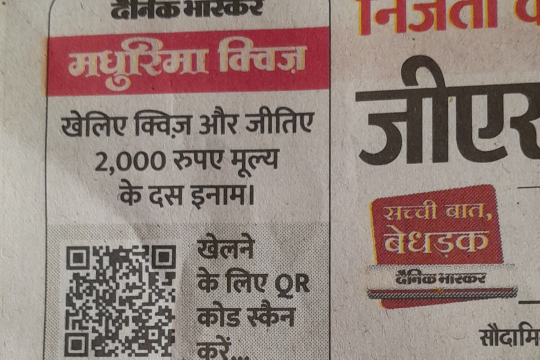
The surveys were conducted with a QR code printed in the newspaper and received 1,027 respondents.
From awareness to action
The campaign didn’t just inform, it also encouraged action. Readers learned how to protect themselves with masks and air purifiers and were advised to report harmful practices, such as burning garbage. The team also explored ideas like citizen helplines and community-level engagement to push for cleaner air.
While the project didn’t directly change policy, it demonstrated how media can spark bottom-up demand for environmental action.
What’s next: Schools and sensors
Building on the encouraging results of the study, Kanishka Kacker, with some more EfD researchers and associates, are now expanding their work to schools. A randomized controlled study is underway in 10 public schools, involving over 100 classrooms. Some classrooms are equipped with air purifiers and receive targeted education on air quality, while others serve as controls.
“We’re measuring everything from lung capacity to cognitive skills,” said Kanishka Kacker. “The idea is to see if awareness and cleaner air can make a measurable difference in children’s health and learning.”
Later this year, the team plans to host a workshop to share findings with schools beyond the study.
By: Petra Hansson.
Follow-up questions answered by Kamesh Dhakar, a resident of the city of Gwalior in the state of Madhya Pradesh.
What made you decide to scan the QR code and take part in the survey?
I felt a sense of responsibility towards society and the environment, so I participated.
When you read the newspaper article series, was there anything that changed the way you think about air pollution?
Yes, I realized that pollution is not just the government’s responsibility — it’s everyone’s.
Did the articles inspire you to do anything differently in your daily life or in your community?
Yes, I’ve started using less plastic and encouraging others to be more aware, too.
What will you remember most from the articles?
The idea that even a small change can be the beginning of a big improvement.