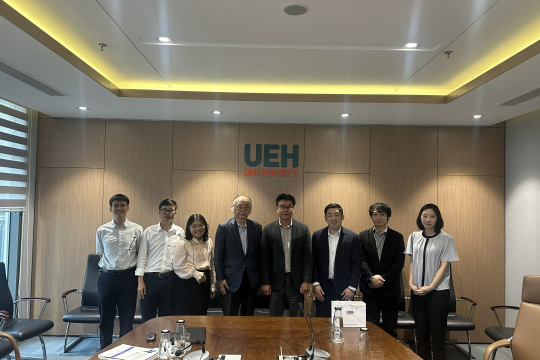
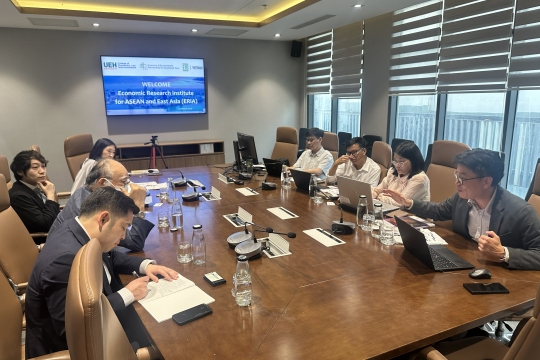
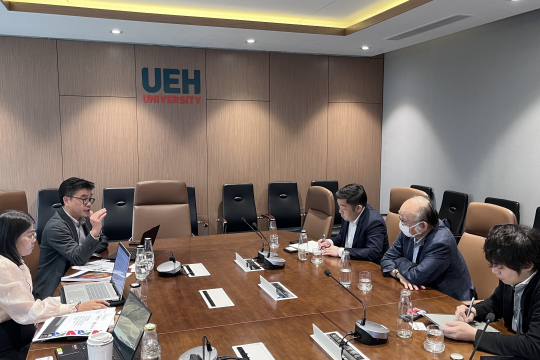
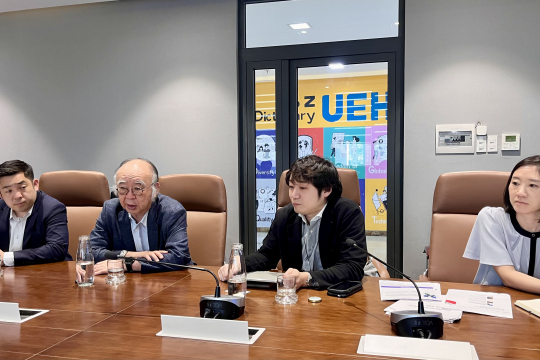
The circular economy is no longer only an environmental issue. It is increasingly seen as a driver of economic growth, innovation, and resource security. EfD Vietnam and a Japanese research delegation met in Ho Chi Minh City to highlight new directions for research, training, and policy on circular economy in Vietnam.
Vietnam is emerging as a key partner in Japan’s initiative to develop a circular economy across ASEAN (Association of Southeast Asian Nations). The meeting, with participation of EfD Vietnam, a joint delegation from the Musashino Institute for Global Affairs (MIGA), Japan, and the Economic Research Institute for ASEAN and East Asia (ERIA), focused on areas for cooperation.
The discussion brought together four members from EfD Vietnam, led by Dr. Pham Khanh Nam, Director of EfD Vietnam, and four representatives from MIGA and ERIA, including Professor Hidetoshi Nishimura, Director of MIGA and former President of ERIA. The meeting focused on how research collaboration can support the transition toward more sustainable production and consumption systems in Vietnam and the region.
Circular economy as an economic opportunity
Japan shared its long-standing experience in recycling and material recovery, particularly in sectors such as automobiles and industrial materials. The proposed approach aims to strengthen regional supply chains by promoting the reuse and recycling of materials across countries.
Vietnam, with its expanding manufacturing base and growing demand for resources, is well-positioned to participate in this regional system.
Areas for collaboration
The meeting identified several practical areas for cooperation.
Human capacity development. Both sides highlighted the need to strengthen training in circular economy, including integrating ESG concepts into higher education and professional programs. Partnerships with Japanese institutions can provide opportunities for students and practitioners to gain hands-on experience.
Joint research and pilot initiatives. A “Living Lab” approach was proposed to test circular economy models in real-world settings, such as university campuses like the UEH Green Campus, as an example. Collaborative research can also help identify gaps in material flows in key sectors, including plastics and automotive industries.
Data and policy support. Improving data availability was identified as a priority. One suggestion is to incorporate circular economy-related questions into national enterprise surveys. This would support more evidence-based policymaking and investment planning.
The role of research and leadership
Both sides underlined the importance of linking academic research with policy and practice.
“The academic community needs to provide policymakers with long-term visions, and help quantify externalities into concrete numbers for decision-making,” Pham Khanh Nam noted.
From the Japanese perspective, Professor Hidetoshi Nishimura emphasized the importance of implementation capacity: “To make this strategy work, the most important question is ‘who will do it?’ Without strong human resources, the expected results cannot be achieved.”
Looking forward
The meeting marks an initial step toward deeper collaboration between Vietnam and Japan on the development of the circular economy. Strengthening research partnerships, investing in human capital, and improving data systems will be essential to translate this vision into practical outcomes.
For EfD Vietnam, the partnership reinforces its role in connecting research with policy, contributing to sustainable development strategies in Vietnam and across ASEAN.