Summary
Blue economy investments are improving livelihoods and food security in coastal communities, but many households are still being left behind. Evidence from nine recent studies in Vietnam, Ghana, and Chile shows that policies are most effective when communities understand, trust, and participate in the institutions that govern fisheries, aquaculture, and coastal resources.
The studies reveal a consistent pattern. Investments in infrastructure, regulations, or technology alone are often not enough. Programs deliver better and more lasting results when they are accompanied by transparent governance, community participation, and local institutions that build resilience.
For governments and development partners, the message is clear: investing in trust and legitimacy is not an optional addition to blue economy policies - it is essential for achieving lasting reductions in poverty and food insecurity.
Why this matters
Coastal and marine resources support the livelihoods of hundreds of millions of people across the Global South. Governments and donors increasingly invest in the blue economy to improve food security, reduce poverty, and protect marine ecosystems.
Research from the BlueRforD collaborative program shows that these investments are already delivering important benefits. However, they do not benefit everyone equally. Across different countries and sectors, the studies point to the same lesson: policies succeed when the people expected to implement or live with them understand them, trust them, and have opportunities to participate in decision-making.
What the evidence shows
Blue economy investments reduce poverty - but not for everyone
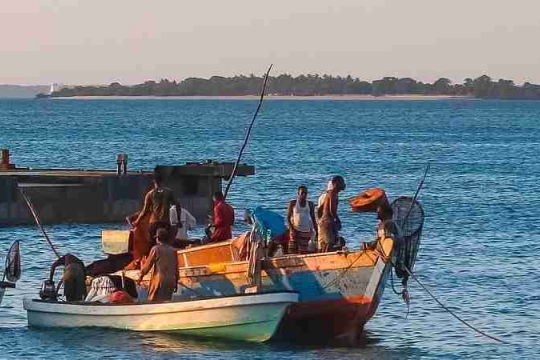
Research from Vietnam shows that small-scale fisheries provide both food security and income for most fishing households. However, around one-third of households remain trapped in poverty and food insecurity despite living in the same coastal communities.
The difference is not simply access to fish. Better outcomes are found where fisheries management is combined with alternative livelihood opportunities: protected households are concentrated in areas where access limits are enforced alongside livelihood support. Restricting access alone is unlikely to reduce poverty unless households also have realistic ways to diversify their incomes.
Trust makes governance more effective
Several studies demonstrate that trust and legitimacy strongly influence whether environmental policies achieve their intended results.
In Vietnam, fishers were much more likely to comply with fisheries regulations when they understood why the rules existed, believed they were fair, and trusted that other fishers were also following them. Financial and social incentives made comparatively little difference to compliance; the study found that where enforcement has been weak for years, using illegal gear has become an accepted local practice rather than a rule violation in fishers' eyes.
Research on aquaculture in Vietnam and Chile reached similar conclusions. Public misconceptions are linked less to a simple lack of information than to the ways people process the information they already have. Greater familiarity with the industry was associated with more balanced perceptions, pointing to a role for communication that addresses these thinking patterns rather than simply supplying more information.
A study of salmon farming in Chile likewise found that successful ecosystem-based regulation depends not only on scientific risk assessments but also on agreement among government, industry, and communities about acceptable levels of environmental risk. The research also showed that decisions to invest in recirculating aquaculture systems (RAS) were driven mainly by cost, while decisions to invest in nature-based solutions (NbS) depended more on environmental impact and the time required to see results. In addition, credible, independently verified sustainability signals are possibly rewarded directly in export markets.
Together, these findings suggest that legitimacy and trust are essential foundations for effective governance.
Strong communities are more resilient
The studies from Ghana show that local institutions can strengthen both environmental management and household resilience.
Communities placed the highest value on mangrove restoration projects that reduced coastal erosion and improved fish stocks rather than simply increasing forest cover. This provides practical guidance for prioritizing restoration investments.
Village Savings and Loan Associations also play an important role by providing financial support where formal social protection is limited. These community-led organizations help households cope with economic shocks and strengthen resilience at relatively low cost.
Research on coastal erosion further shows that engineering solutions alone are insufficient. Combining infrastructure with community engagement and nature-based approaches is likely to produce more durable results: protecting coastal assets while maintaining biodiversity.
Policy implications
The evidence points to three priorities for future blue economy investments.
1. Target households that remain vulnerable
Many blue economy policies improve average outcomes while leaving a significant minority behind. Governments should combine fisheries management with livelihood diversification and direct support for households that remain vulnerable.
2. Invest in legitimacy alongside regulation
Every major investment in fisheries management, aquaculture regulation, or environmental protection should include funding for communication, stakeholder participation, and transparent decision-making.
Where certification schemes exist, governments and donors should help producers, especially smaller operators, access them, since credible market signals reward the same legitimacy that regulation depends on.
Building trust is not a separate activity from governance, it is part of making governance work.
3. Strengthen community institutions
Governments and donors should recognize community-based savings groups and participatory natural resource management as valuable complements to formal social protection systems.
These locally established institutions already have community support and can often be expanded at relatively low cost.
Addressing a common concern
Some policymakers may argue that stronger enforcement or larger financial incentives would be quicker than investing in participation and trust.
The evidence suggests otherwise.
In Vietnam, weak legitimacy was the main reason fishers ignored regulations, not insufficient penalties. In Chile, managers facing the greatest climate risk were the least likely to adopt new technology, showing that mandating a technology choice without addressing underlying risk perception and social acceptability is unlikely to accelerate adoption. In Ghana, coastal defenses alone have not prevented continuing environmental degradation without addressing local drivers of resource use.
Across all three countries, the studies reach the same conclusion: policies are more likely to succeed when they are developed with communities rather than simply imposed on them.
Conclusion
Across fisheries, aquaculture, and coastal ecosystem management, the evidence consistently shows that blue economy investments deliver the greatest benefits when they are supported by trusted institutions and active community participation.
Future investments should therefore combine physical infrastructure, regulations, and new technologies with equally strong investments in transparency, communication, and local institutions. Doing so will increase the likelihood that blue economy policies reduce poverty, improve food security, and strengthen resilience for all coastal communities—not only for those who are already better positioned to benefit.
References
[1] Xuan, B.B., Ngoc, Q.T.K., Armstrong, C.W., Vondolia, G.K., Nam, P.K. (2026). Understanding non-compliance with rights-based fisheries management in Vietnam. Environmental and Resource Economics.
[2] Ngoc, Q.T.K., Xuan, B.B., Nam, P.K. (2026). The dual role of small-scale fisheries on food security and poverty eradication in Vietnam: A latent profile analysis. World Development.
[3] Salazar, C., Jaime, M., Ho, T., Nie, Z., Jiang, Y., Dresdner, J. (2026). Do information processing biases drive local community misconceptions of aquaculture? Evidence from harmonized surveys in Chile and Vietnam. Journal of Environmental Management.
[4] Salazar, C., Jaime, M., Hernández, F., Chávez, C., León, J. (2026). Preferences for sustainable transitions in Chilean land-based salmon farming: RAS vs. NbS. Aquaculture Economics & Management.
[5] Soto, D., Montes, R.M., Quiñones, R.A., León-Muñoz, J., Fuentes, M.E. (2026). Risk is not equal to impact: The challenges of developing a traffic light system to regulate farmed salmon production on an ecosystem scale. Reviews in Aquaculture.
[6] Estay, M., Salazar, L. (2026). The impact of eco-certifications on the price of salmon products. Aquaculture Economics & Management.
[7] Tunyo, D.A., Vondolia, G.K., Xuan, B.B. (2026). Valuing mangrove management options in Ghana using discrete choice experiments. Ocean & Coastal Management.
[8] Salifu, I., Vondolia, G.K., Aheto, D.W. (2026). Behavioural drivers of village savings and loan association participation for social protection in small-scale fishing communities. Discover Sustainability.
[9] Daddah, P., Asmah, E.E., Akpalu, W., Achen, A., Gnansounou, S.C. (2026). At the edge of the sea: Coastal erosion, asset loss, and management challenges, evidence from selected coastal communities in Ghana, West Africa. Coastal Management.