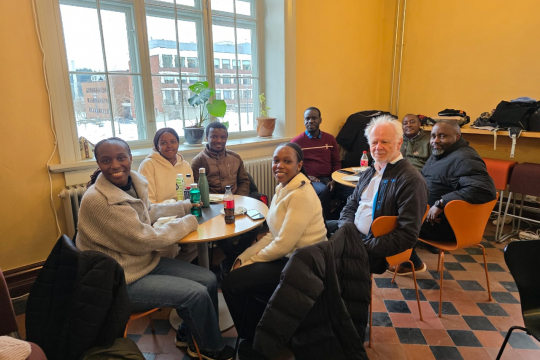
The Energy Economics, Governance and Research Competence Building (EEGREC) project aims at strengthening access to affordable, clean, and reliable energy within a lower-carbon development pathway. The project partners met in Oslo, Norway, to review progress, share lessons, and define strategic priorities for the coming year.
The project addresses the ongoing global energy transition characterized by the “Three Ds”: Decarbonization, Decentralization, and Digitization. These transitions are reshaping energy systems worldwide and present both opportunities and policy challenges for developing economies. They require new analytical skills, regulatory approaches, and research capacity to guide investment, governance, and institutional reforms in the energy sector.
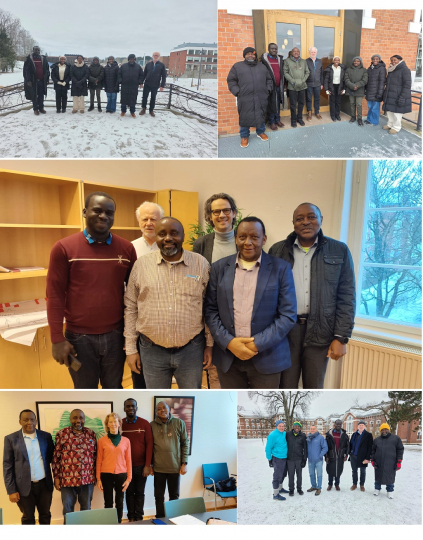
The project partners convened in Oslo for their annual implementation meeting under the NORHED II Programme 2021–2026. The meeting was hosted by the Norwegian University of Life Sciences (NMBU) and brought together key institutional partners.
The University of Dar es Salaam School of Economics (UDSE) was represented by members from EfD Tanzania. They joined colleagues from the Makerere University Business School (MUBS), while the host institution, NMBU, was also represented at the meeting
Equipping graduates and faculty with specialized tools
The collaboration is financed through a grant awarded by the Norwegian Agency for Development Cooperation (Norad) to NMBU under the NORHED II framework, which supports higher education capacity building partnerships between institutions in Norway and the Global South.
Stephen Kirama emphasized the importance of building local expertise to navigate this transformation. He noted that “the energy transition is not only a technological shift but also a governance and policy challenge. Strengthening capacity in energy economics ensures that our countries are not just observers, but active contributors to shaping sustainable energy systems.”
The EEGREC project builds on the earlier NORHED I initiative on Capacity Building in Education and Research for Economic Governance by expanding its focus to energy economics and governance, equipping graduates and faculty with specialized tools to respond to rapidly changing energy landscapes.
Academic programs under institutional review
One of the key components of the project is developing academic pathways in Energy Economics at the University of Dar es Salaam. These include a proposed Bachelor of Arts in Energy Economics, a proposed Master of Arts in Energy Economics, and a proposed PhD Program in Energy Economics.
The curricula for these programs have been developed by the University of Dar es Salaam and School of Economics NORHED II Members, and have been presented and discussed for comments by the partner members from MUBS and NMBU. The programs will undergo the formal academic approval process of the University of Dar es Salaam before implementation.
In addition to curriculum development, the project has supported four Master’s scholarships and two PhD scholarships, as well as staff and student mobility for fieldwork, conferences, joint supervision, and collaborative teaching across partner institutions. Gender mainstreaming has also been integrated into research and training activities to promote inclusive capacity building.
“Developing these programs is a strategic step, but equally important is ensuring they meet the University’s academic standards and national accreditation requirements. Once approved, they will significantly strengthen our institutional capacity in energy economics,” said Stephen Kirama.
Tangible progress and growing impact
The annual meeting reviewed notable progress in research training and academic collaboration. Several master’s students supported under the project have completed their studies, while PhD candidates are at advanced stages of their research. This growing cohort of scholars reflects the program’s contribution to strengthening research competence and academic excellence in the region.
Beyond degree completion, the partnership continues to foster collaborative research, joint publications, and academic exchange between East African institutions and Norway.
Looking ahead: strengthening policy-relevant expertise
Partners reaffirmed their commitment to expanding research outputs, enhancing policy engagement, and deepening regional and international collaboration. The shared vision is to increase the number of highly trained graduates in Energy Economics and Governance who can actively contribute to policy formulation and implementation, particularly in the Global South.
“Our long-term objective is to ensure that research produced within our institutions informs real policy decisions. Capacity building must translate into measurable development impact,” concluded Stephen Kirama.
Through sustained collaboration under NORHED II, MUBS, NMBU and UDSE through EfDT continue to strengthen their role as key contributors to energy policy analysis, research excellence, and institutional capacity development in Africa and beyond.
By Salvatory