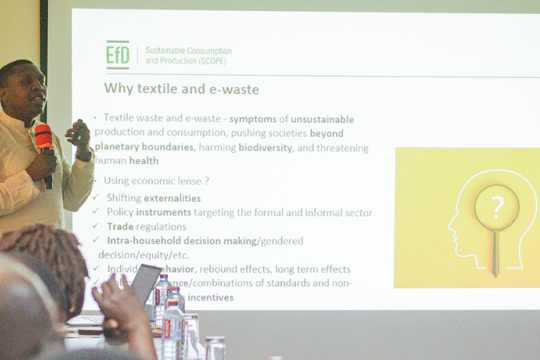
Stakeholders from government institutions, regulatory bodies, Accra city management authorities, and industry have shared insights to inform an ongoing study on Ghana’s growing challenges related to e-waste and textile waste. Organized under Sustainable Consumption and Production (SCOPE) Collaborative, the two-day engagement provided an early platform to draw on institutional experience and industry knowledge to help refine the research focus and ensure policy alignment ahead of planned household surveys.
“We recognise that we do not have all the answers. That is why we have invited you, with your expertise and experience in these areas, to help us refine our understanding of the issues we are investigating,” said project lead Kwami Adanu in his welcome address.
Participants included representatives from the Ministry of Local Government, Chieftaincy and Religious Affairs (MLGCRA), the Accra Metropolitan Assembly (AMA), the Environmental Protection Agency (EPA), the Ministry of Environment, Science, Technology and Innovation (MESTI), the Ghana Revenue Authority (GRA), and second-hand clothing dealers. Discussions focused on regulatory frameworks, enforcement realities, trade dynamics and operational pressures within Ghana’s waste management system.
100 tons of waste daily
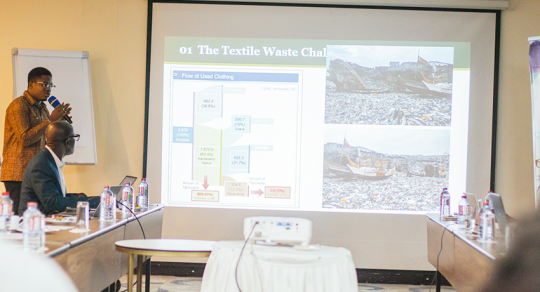
“Over 100 tons of waste is produced daily; we collect substantial volumes from the streets of Accra, and it is becoming a growing challenge,” Mr. Victor Kotey of the Waste Management Department at the AMA said, underscoring the scale of pressures facing the capital.
He noted that waste from the second-hand clothing trade constitutes a significant share of the burden confronting city authorities, highlighting the urgency of addressing textile waste within broader urban waste management efforts. He noted that waste from the second-hand clothing trade constitutes a significant share of the burden confronting city authorities, highlighting the urgency of addressing textile waste within broader urban waste management efforts.
Unclear standards, poor data and insufficient financing
Sharing the policy perspective, Godfred Boadi of MLGCRA outlined the scale and complexity of Ghana’s textile waste landscape. With more than 137,000 tons of second-hand clothing imported annually, the environmental and public health implications are considerable. Although a policy framework exists, operationalisation remains constrained by unclear standards, fragmented data systems, and underdeveloped financing mechanisms.
Michael Gyasi of the GRA shed light on the role of customs in promoting cleaner trade, safer communities, and a functional circular economy, explaining how trade monitoring and enforcement align with national efforts to manage waste inflows and strengthen circularity.
Mutual learning across the waste value chain

The discussions proved illuminating for both researchers and participants, deepening collective knowledge and understanding of the distinct roles played by actors across the waste value chain and the efforts already underway to address the challenge.
For instance, Madam Gloria Asiamah, a leader in Kantamanto, Ghana’s largest second-hand clothing market, shared how market leaders are organizing waste disposal and maintaining cleanliness within the market.
Aligning research priorities and closing critical data gaps
Importantly, the workshop also created space for the research team to present the study framework and outline the data gaps it seeks to address. Project Lead Kwami Adanu and Kevin Maina, Postdoctoral Fellow on the project, explained the study's aim to strengthen the evidence base on textile and electronic waste flows, particularly where current data remain limited or fragmented. This exchange allowed participants to see how their insights could directly inform the research design and ensure its relevance to real-world challenges.
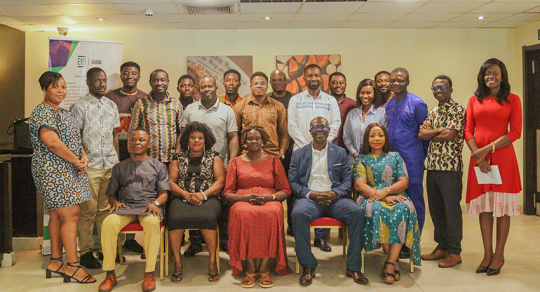
Beyond the shared learning, the two-day event, held on 26–27 February at the Lancaster Hotel in Accra, was vital in aligning research priorities, closing critical data gaps, and strengthening relationships with the key stakeholders whose support will be essential to the study's successful implementation in Ghana.
By Vicentia Quartey