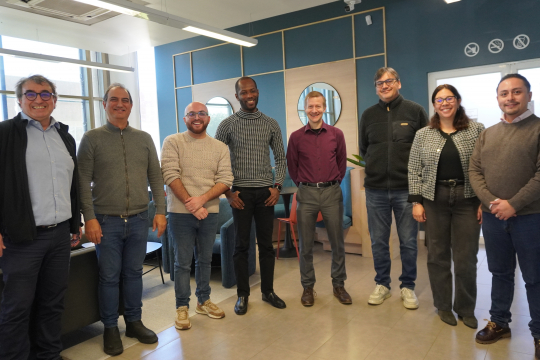

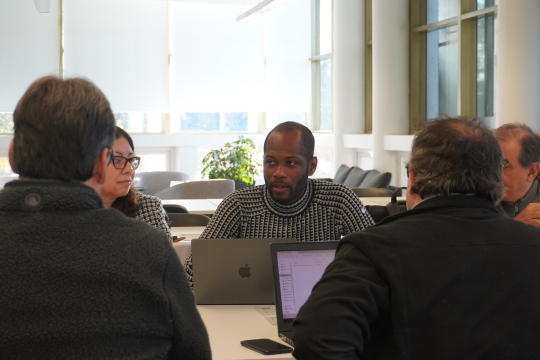
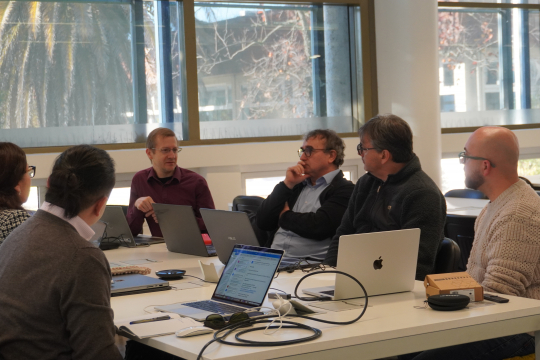
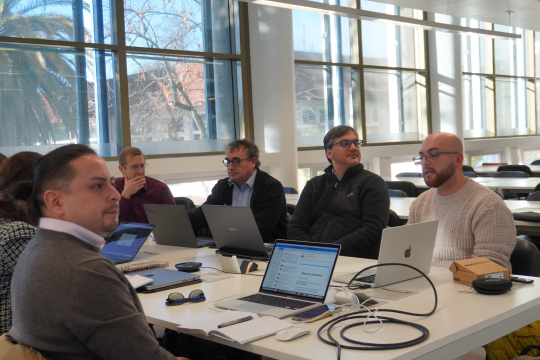
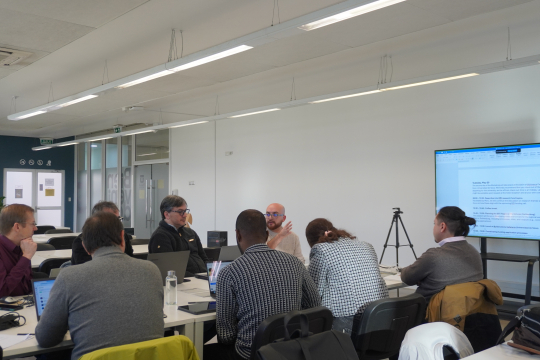
The Sustainable Energy Transition Initiative (SETI) held a workshop to establish a research agenda, a strategic plan for the SETI group, collaborative research proposals for international funding, and plans for the upcoming annual meeting. This workshop took place on May 19-20 at the University of Talca, Chile.
For two days, the hybrid workshop Strategic Plan and Research Agenda 2025-2027 gathered SETI fellows and members of the SETI local team, Marc Jeuland, Marcela Jaime, Carlos Chávez, Walter Gómez, Mauricio Oyarzo, César Salazar, Cristóbal Vásquez, the head of research from the University of Talca, Roberto Jara, EfD Global Hub researcher Franklin Amuakwa-Mensah, and SETI postdoctoral fellow Selamawit Kebede and SETI researcher Philip Kofi Adom; to review SETI’s strategic processes and its activities from the program's inception to the present, and began working on research proposals in detail. Strong focus has been placed on developing policy impactful research for the Sub-Saharan African region.
The discussions underscored the importance of continuing to support knowledge exchange between researchers, policymakers, and students. Participants highlighted the need to promote the development of research proposals with strong policy relevance, facilitate the involvement of early-career researchers, and enhance SETI’s impact by engaging with decision-makers at early stages of research processes and leveraging strategic opportunities.
Three major research Work Packages
SETI reaffirmed its commitment to producing high-impact, policy-relevant research on sustainable energy transitions, particularly in the Global South. The group emphasized the need for a more strategic and collaborative approach.
This includes co-creating research with policymakers from the outset (e.g., defining challenges, designing questions, and identifying effective policy levers together). SETI also aims to strengthen South-South collaboration by fostering cross-country partnerships within the EfD network and developing regional or thematic hubs (e.g., clean energy hub in East Africa) for joint research proposals or other network activities. Additional efforts will focus on supporting early-career researchers through mentorship, seed grants, etc.
“The objective of our initiative is to generate solid research that has a strong impact at the academic and disciplinary level, but also to inform and contribute to the design and evaluation of public policy on environmental matters,” said Marcela Jaime, Co-Leader of SETI and Director of NENRE EfD-Chile.
The meeting resulted in the identification of three major research clusters that will guide SETI’s work going forward to 2027:
-
Clean energy solutions and welfare, examining both financial and non-financial impacts;
-
Inclusiveness and equity, focusing on gender, intersectionality, and distributional outcomes;
-
National and subnational governance, including institutional capacity, multi-level coordination, and regional disparities.
SETI Co-Leader Marc Jeuland underscored the value of comparative research across diverse regional contexts to foster learning and design interventions that support countries in meeting their energy transition goals.
These areas help guide the SETI network to prioritize research efforts while remaining adaptable to country-specific needs, particularly in Sub-Saharan Africa.
What are the overarching goals of SETI?
SETI is an interdisciplinary global collaborative that fosters research on energy access and energy transitions in low and middle-income countries, to better understand their drivers and dynamics, as well as their impacts on health, gender equality, economic growth, poverty alleviation, climate change and natural resources.
For supporting this vision, SETI is structured on the following objectives:
-
Take stock and continuously update what is known about the impacts of energy transitions, and especially how they relate to economic development.
-
Develop and implement a decentralized, yet coordinated, network research strategy that speaks to, via a co-production model with decision makers, knowledge gaps and policymakers’ perceptions of the most critical needs for evidence.
-
Work to create and capacitate a network that features and facilitates North-South and South-South collaboration and research of a comparative nature.
-
Provide knowledge and advice, generated using rigorous and innovative methods, for maximal impact in reducing energy poverty. and energy-related constraints to development.
The group will continue building on these foundations in the lead-up to the SETI Annual Meeting in Gothenburg this August, where research workshops will further advance the development of joint proposals and reinforce SETI’s commitment to impactful, context-driven energy research.
By Belén Pulgar.